Canada PNP vs Express Entry: Which Pathway Is Faster for Indians in 2026?
Canada now has two main routes to permanent residency for skilled workers. One is Canada PNP, and the other is Express Entry. This is the first decision most Indian applicants get stuck on when planning their Canada PR application, and they often assume one is universally faster than the other. It isn’t that simple. Your CRS score decides which pathway actually gets you an Invitation to Apply sooner, and the gap between the two can run into years for the wrong candidate.
This guide walks through the 2026 processing times, fees, and eligibility rules for Canada PNP vs Express Entry, so you can pick the one that fits your profile.
| Key TakeawaysBefore choosing Canada PNP vs Express Entry, compare CRS score, occupation, eligibility, provincial options, costs and the total timeline, including any nomination stageExpress Entry is usually faster if your CRS score is already competitive enough for current draws.PNP can be the better option if your CRS score is too low to receive an ITA through regular Express Entry draws.An enhanced PNP nomination adds 600 CRS points, significantly improving your chances of receiving an ITA.PNP can take longer overall because you need to complete the provincial nomination stage before the federal PR process.Express Entry is generally cheaper because PNP applicants may also have to pay a provincial nomination fee.Your CRS score, occupation, work experience, job offer and provincial eligibility should all be considered before choosing a pathway.There is no universally faster option, the right route depends on your individual profile and the current 2026 immigration rules. |
Understanding Canada’s Two Major PR Pathways
Both Canada PNP and Express Entry lead to the same outcome, a permanent resident card, but they get you there through different rules. Before comparing speed and cost, it helps to know exactly how each system works.
What Is Express Entry?
Express Entry is the online system IRCC uses to manage applications under three federal economic programs:
- The Federal Skilled Worker Program (FSWP),
- The Federal Skilled Trades Program (FSTP),
- The Canadian Experience Class (CEC).
You create a profile, IRCC ranks you using the Comprehensive Ranking System (CRS), and candidates with the highest scores receive an Invitation to Apply (ITA) in regular draws. There’s no requirement to know anyone in Canada or to have a specific province in mind. You compete on your profile alone based on age, education, work experience, and language scores.
What Is the Provincial Nominee Program (PNP)?
The Provincial Nominee Program in Canada allows participating provinces and territories to nominate candidates who meet their regional economic and labour-market needs.
Each province or territory has its own streams and requirements. These can differ considerably in terms of occupation, work experience, language ability, education, job offers, and connections to the province. Quebec and Nunavut do not operate PNPs.
A PNP nomination can be:
- Enhanced, meaning it is connected to Express Entry.
- Base, meaning the nomination operates outside Express Entry.
For an enhanced nomination, the candidate receives 600 additional CRS points, which can make an ITA highly likely in a subsequent PNP-specific Express Entry round.
Unsure about your CRS Score? Check here→ Canada CRS Score Calculator
Canada PNP vs Express Entry: Key Differences
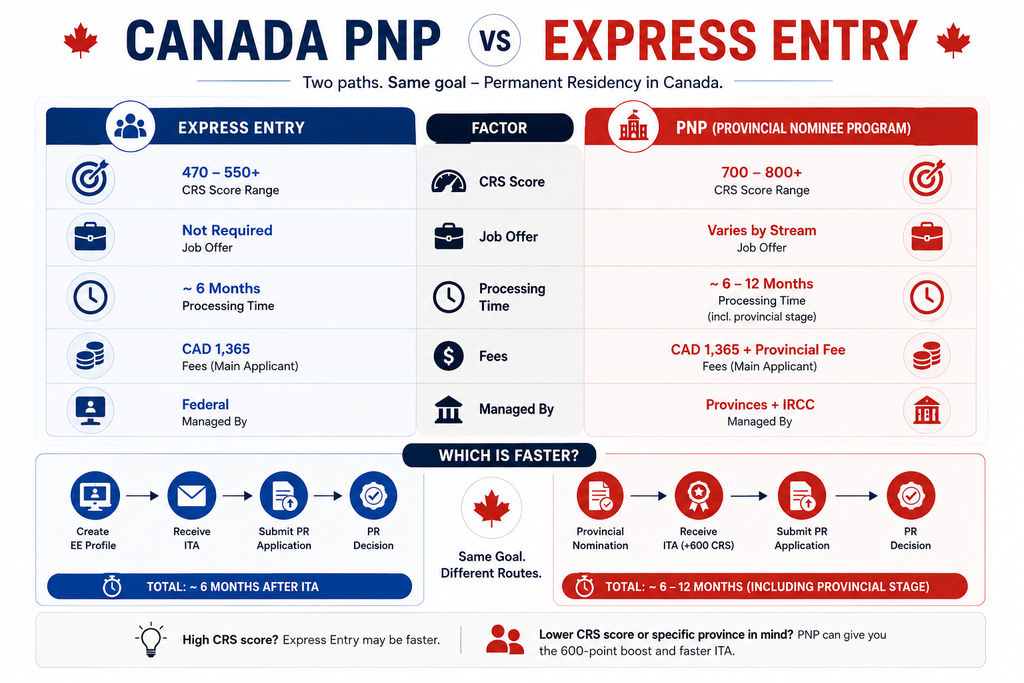
| Factor | Express Entry | PNP |
| Managed by | Federal government | Provinces/territories + IRCC |
| Eligibility basis | Meeting minimum FSWP, FSTP, or CEC criteria: skilled work experience, language scores, and (for FSWP) an ECA | Set by each province; ranges from employer job-offer streams to occupation-based streams with no Canadian connection required |
| CRS score needed | General draws: 470–550. CEC draws: 507–518. Category-based draws (French, healthcare, and others): as low as the 390s–460s | Draws are often at 700–800+, but this already includes the automatic 600-point nomination bonus. |
| Job offer | Not required. A valid LMIA-backed job offer adds CRS points, but many candidates are invited without one, especially through CEC or category-based draws | Varies by stream. Employer-driven streams require a genuine job offer. Human-capital or “no job offer” streams do not usually require |
| Provincial nomination bonus | Not applicable | Adds 600 CRS points when accepting the nomination. Since almost every Express Entry draw cutoff sits below 600, a nomination guarantees your next ITA within a draw or two |
Processing structure | One main federal PR application after ITA | Provincial stage followed by federal PR stage for many PNP routes |
Best suited to | Strong, competitive profiles | Candidates who match provincial labour-market needs |
A PNP route tends to be the realistic option for applicants whose CRS score, without a nomination as it sits well below what general or CEC draws demand. The real appeal of PNP isn’t lower requirements. It’s a way around the CRS ranking system altogether.
Processing Time Comparison in 2026
Processing time is usually the deciding factor for applicants comparing these two routes, so here’s what IRCC’s own service standards and 2026 draw data show for each.
There are two separate things to measure:
- How quickly do you receive an ITA?
- How quickly does IRCC process your PR application after submission?
A PNP may improve the first part substantially for a candidate with a low CRS score, but it adds a provincial selection stage.
Express Entry Processing Timeline
The Express Entry process broadly looks like this:
| Eligibility → Express Entry profile → CRS ranking → ITA → PR application → IRCC processing → decision |
IRCC’s January 31, 2026 data showed a forward-looking wait of approximately:
- 6 months for Federal Skilled Worker applications
- 7 months for Canadian Experience Class applications
These figures relate to the federal PR processing stage, not the time spent waiting in the Express Entry pool before receiving an ITA.
IRCC also reported that from June 2025 to May 2026, approximately 79% of Federal Skilled Worker Program and Canadian Experience Class applicants received a decision within the six-month service standard.
PNP Processing Timeline
PNP applicants may have to complete a provincial nomination stage before applying for federal permanent residence.
- For Express Entry-linked PNP applications, IRCC’s January 2026 data showed a forward-looking processing time of approximately 7 months for the federal PR stage.
- For non-Express Entry PNP applications, the corresponding forward-looking figure was approximately 13 months.
These figures do not include the time required to obtain the provincial nomination.
A candidate who already has a nomination may move through the federal stage in a timeframe similar to an Express Entry applicant. Someone starting from zero through a PNP must account for the provincial application and nomination stage first. That step alone can range from a few weeks (in fast provincial streams with weekly draws) to several months if a stream has capped intake or the province is reviewing a large backlog of applications.
Which Option Gets You PR Faster?
For most Indian applicants, enhanced PNP tends to win the speed race, but only once you already have the nomination in hand. A candidate with a 480 CRS score sitting in the Express Entry Draw might wait months (or indefinitely, if no draw ever dips that low) for an invitation. The same candidate, nominated by a province, jumps straight past every general draw cutoff and gets an ITA within weeks.
But if your CRS score already clears the general or CEC draw cutoffs on its own, applying for a PNP first only adds time. You’d be waiting for a provincial decision you don’t actually need. In that case, straight Express Entry is faster because it skips the nomination step entirely.
Base (non-Express Entry) PNP is almost always the slowest route of the three, given the 12-to-18-month processing window, and should generally be a fallback rather than a first choice.
Cost Comparison Between PNP and Express Entry
Federal fees are the same no matter which route you take, but PNP applicants carry one extra cost that Express Entry-only applicants don’t. Here’s the full breakdown.
Government Fees
As of April 30, 2026, for Federal High Skilled programs and the PNP, the principal applicant processing fee is now CAD $990. The Right of Permanent Residence Fee is CAD $600 for the principal applicant and accompanying spouse or common-law partner. Dependent children have a separate fee of CAD $270 and do not pay the Right of Permanent Residence Fee.
For a single adult, this means the main federal PR fees are:
| Fee | Amount |
| PR processing fee | CAD $990 |
| Right of Permanent Residence Fee | CAD $600 |
| Total | CAD $1,590 |
Biometrics run CAD 85 per person, capped at CAD 170 for a family applying together.
Provincial Nomination Costs
This is the extra cost PNP applicants carry that Express Entry-only applicants don’t. Provincial nomination fees vary widely:
- Ontario’s Express Entry-aligned stream has charged around CAD 1,500,
- Alberta’s worker streams have added roughly CAD 1,500 plus a separate Expression of Interest fee, and
- Saskatchewan introduced a new CAD 500 fee for skilled-worker streams with a job offer starting in April 2026 (a category that was previously free).
These fees are paid to the province directly, on top of federal IRCC charges, and they’re generally non-refundable even if your nomination or PR application is later refused.
Other Expenses to Consider
While comparing the costs of the Canada PNP vs Express Entry option, budget for expenses such as:
- English or French language testing
- Educational Credential Assessment (ECA), where required
- Police certificates
- Medical examination
- Biometrics
- Translation or certified document services, where applicable
- Provincial application fees, if applicable
- Professional consultation fees, if you choose to use an immigration professional
IRCC specifically identifies medical examinations, police certificates, language assessments, and ECAs as potential third-party costs.
Applicants under the Federal Skilled Worker Program and Federal Skilled Trades Program may also need settlement funds. The current IRCC table lists CAD $15,263 for one family member, with the amount increasing according to family size.
Pros and Cons of Express Entry
| Advantages | Disadvantages |
| No provincial nomination fee, which keeps total costs lowerFaster once you’re invited, since it avoids the added wait for a provincial decisionFlexible: you can settle in any province after landing, not just the one that nominated youCategory-based draws (French, healthcare, and others) sometimes have much lower cutoffs than the general pool | Requires a genuinely competitive CRS score, which many candidates without Canadian work experience or a strong IELTS band struggle to reachNo guarantee of an ITA within any fixed timeframe if your score sits below current cutoffsDraw cutoffs and categories are announced at IRCC’s discretion, making it hard to plan around a specific date |
Pros and Cons of Provincial Nominee Program
| Advantages | Disadvantages |
| The 600-point bonus effectively guarantees an ITA once nominated, regardless of your original CRS scoreSome streams (especially in Saskatchewan, Manitoba, and Atlantic provinces) accept candidates without Canadian experience or a job offerUseful for candidates in occupations that don’t score well federally but are in high demand provincially | Comes with an additional provincial fee on top of federal chargesBase (non-Express Entry) streams can take 12–18 months to process, erasing any time advantageMost streams expect a genuine intention to live in that specific province, and some verify this after landingProvincial nomination deadlines are strict, typically 30–60 days from invitation to acceptance, leaving little room for delay |
Which Option Is Better for Indian Applicants?
The right pathway comes down to your current CRS score and whether you have a job offer, not a generic recommendation. Here’s how that plays out across common applicant profiles.
Candidates With High CRS Scores
If your CRS score already sits above 500–520, straight Express Entry is usually the faster and cheaper choice. Chasing a PNP nomination in this case adds a fee and a waiting period.
Candidates With Lower CRS Scores
If you’re sitting below 450–470 without a Canadian job offer or study history, an enhanced PNP nomination is often the right path to an ITA within a reasonable timeframe. Consider provinces whose in-demand occupation lists match your NOC code, since that’s what actually improves your odds of nomination.
Applicants Without a Job Offer
Several provinces run Express Entry-aligned streams that don’t require a job offer. They focus on human capital factors, in-demand occupations, or a scoring system based on skill level and wage.
Applicants With Provincial Demand Occupations
If your occupation shows up on a province’s priority list (healthcare, skilled trades, and tech roles are common examples across Ontario, Alberta, and BC), that’s usually your strongest signal to apply for that specific PNP stream rather than waiting for general Express Entry draws.
Stuck with a low CRS Score? Explore: Improve your CRS Scores by 50+ Points
Can You Apply for Both Express Entry and PNP?
Yes, and for most candidates, this is the smarter approach. You can maintain an active Express Entry profile while simultaneously applying to one or more provincial streams that match your profile. If a general draw invites you first, take it. If a province nominates you first, your CRS score jumps, and you get an ITA in the next round.
Common Mistakes Applicants Make
Most delays in this process come from avoidable errors, not from IRCC or provincial backlogs. We have seen these three most common mistakes admitted among Indian applicants.
- Choosing the Wrong Province
Applicants often apply to whichever province seems popular, without checking if their occupation, education, or work history actually matches that province’s current priority list.
- Ignoring CRS Improvement Opportunities
Many candidates settle for a mediocre CRS score instead of retaking a language test or pursuing a second language. A jump from CLB 7 to CLB 9 in English, or building basic French proficiency, can add enough points to clear a general draw without needing a provincial nomination.
- Missing Provincial Deadlines
Provincial nomination invitations come with strict acceptance windows, often 30 to 60 days. Missing that window because of delayed document collection means starting over, sometimes with a different, less favourable stream.
How VisaAxis Helps You Choose the Right PR Pathway
The right Canada PR pathway should be based on your actual profile rather than a generic recommendation. Our Canada immigration experts at VisaAxis provide immigration and visa consultancy services, including Canada PR guidance and eligibility assessment.
Eligibility Assessment
We review your profile against both federal and provincial criteria to identify which pathways you actually qualify for, rather than which ones sound appealing.
Express Entry Profile Assistance
If your CRS score is competitive, we help you build an accurate Express Entry profile to and flag any gaps.
Provincial Nomination Support
For candidates who need a PNP route, we help identify which provinces are actively nominating candidates in your occupation and guide you through the specific documentation each stream requires.
End-to-End Canada PR Guidance
From your first eligibility check through to your PR application submission, VisaAxis works alongside you at each stage.
Conclusion
So for those comparing Canada PNP vs Express Entry timelines, neither PNP nor Express Entry is universally “faster.” The key is to compare the entire timeline, not just the IRCC processing time. A PNP can take longer overall because of the provincial nomination stage, while still being the better option for someone who may otherwise wait indefinitely in the Express Entry pool.
Canada’s 2026 immigration policy is also more targeted, with greater emphasis on Canadian work experience, priority occupations, French-language ability, and regional labour needs.
If you’re unsure where you stand, get your profile assessed before you commit months of paperwork to either route. Connect with Visa Axis to understand your options and choose the best way for your case.
Which is faster: Canada PNP or Express Entry?
It depends on your CRS score. If your score already clears the general or CEC draw cutoffs, straight Express Entry is faster since it skips the provincial nomination step. If your score is well below current cutoffs, an enhanced PNP nomination is usually faster overall, because the 600-point bonus gets you an ITA that a low CRS score alone wouldn’t.
What is the difference between Express Entry and the Provincial Nominee Program?
Express Entry is a federal system that ranks candidates on CRS score alone. The PNP lets individual provinces nominate candidates based on local labour needs, and an enhanced nomination adds 600 CRS points, feeding back into the Express Entry system.
Can I apply for both Express Entry and PNP at the same time?
Yes. Most applicants keep an active Express Entry profile while also applying to enhanced PNP streams. Whichever comes first, a general draw or a provincial nomination, moves your application forward.
Does PNP guarantee Canadian permanent residency?
No. A provincial nomination significantly improves your chances of getting an ITA, but your PR application still goes through IRCC’s standard review, including medical exams, background checks, and document verification. Approval isn’t automatic.
Is a job offer required for Express Entry?
No. A valid, LMIA-backed job offer adds CRS points, but many candidates receive an ITA through CEC or category-based draws without one.
How does a provincial nomination affect my CRS score?
Accepting an enhanced provincial nomination adds 600 points to your CRS score in the Express Entry system. Since almost every draw cutoff in 2026 has stayed below 600, this effectively guarantees your next ITA.
Which Canadian provinces have the easiest PNP programs?
“Easiest” depends on your occupation and profile. Saskatchewan and Manitoba have historically run streams open to candidates without a job offer or Canadian experience, while Ontario updated its program structure in June 2026, moving to a single new Workforce Priority stream focused on select occupations. Eligibility shifts often, so confirm current streams before applying.
Is Express Entry cheaper than applying through a PNP?
Yes, generally. Both pathways carry the same federal IRCC fees (CAD 1,590 for a principal applicant as of the April 2026 fee schedule), but PNP applicants pay an additional provincial nomination fee, which ranges from around CAD 500 to CAD 1,500 depending on the province and stream.