Canada Super Visa Application Denied for Your Parents: Fixing Income and Insurance Gaps
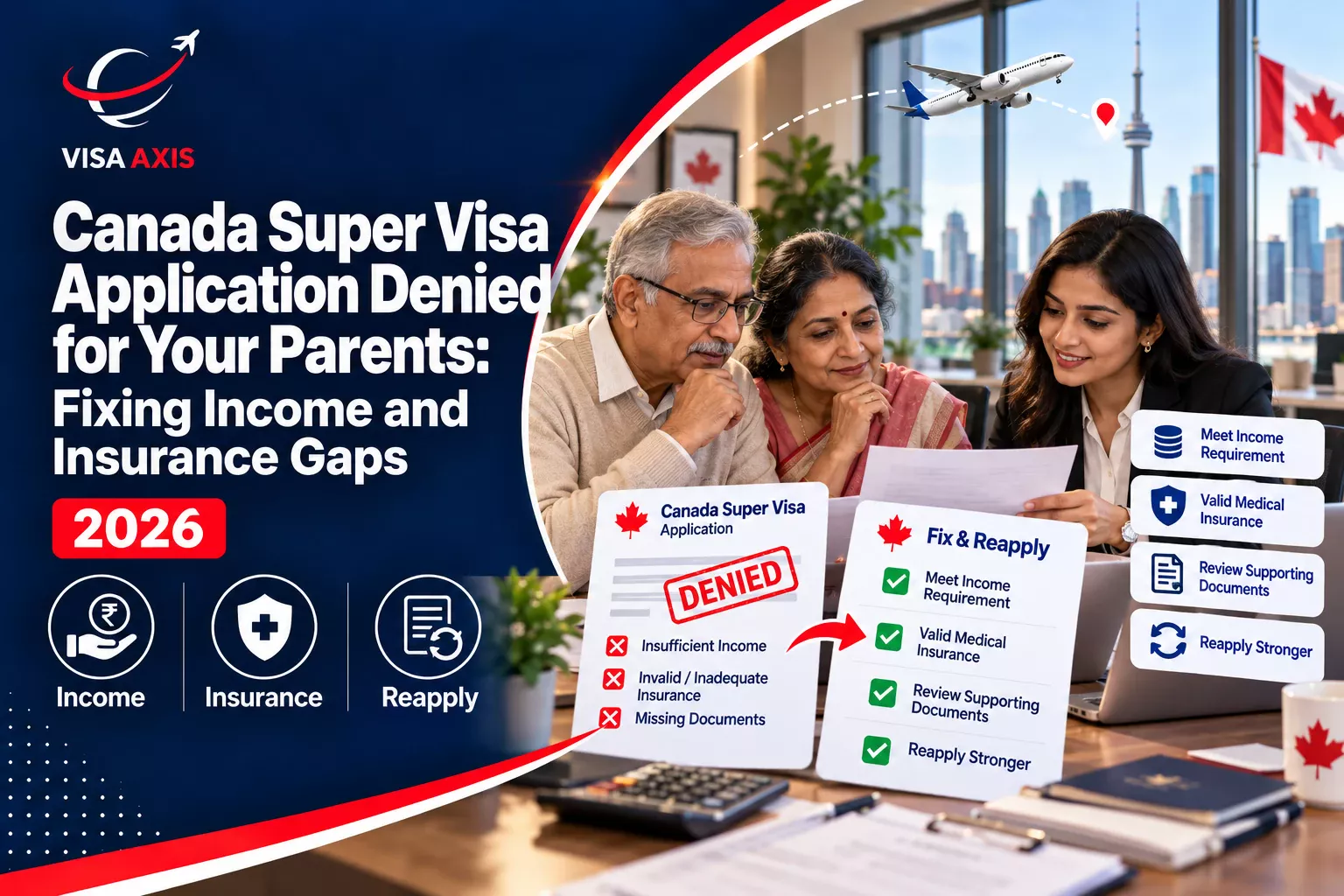
A Canada Super Visa refusal is often caused by an income shortfall, incorrect family-size calculation, non-compliant insurance policy, or insufficient supporting evidence rather than the purpose of the visit itself.
To reapply successfully, you must first understand the specific reasons for rejection instead of resubmitting the same documents.
Under rules effective March 31, 2026, applicants can use more flexible income assessment options to help meet financial requirements. This guide outlines how to fix application gaps to build a stronger application.
Why Was Your Parents’ Canada Super Visa Application Denied?
A Canada Super Visa application can be refused if the applicant or their host does not meet the eligibility requirements. Immigration officers also assess whether the parents are genuine visitors who will leave Canada when their authorised stay ends.
Before preparing another application, separate the refusal reasons into specific issues. For example, a refusal related to insufficient host income requires a different response from one involving medical inadmissibility or concerns about the parents’ intention to leave Canada.
Understanding the Refusal Letter Before Reapplying
Start by identifying each reason given by the officer and match it against the documents submitted with the original application.
Since July 29, 2025, IRCC has provided officer decision notes with most temporary resident application refusals, including Super Visa applications. These notes explain the officer’s assessment and can provide more detail than the refusal letter alone.
Read both documents together. Check whether the concern relates to:
- The host’s income or the calculation of family size.
- The validity, duration or payment status of medical insurance.
- Missing evidence of the relationship between the parents and their child or grandchild in Canada.
- Concerns about the applicant’s financial circumstances, family ties, or purpose of travel.
- Medical, criminality, or other admissibility issues.
The Most Common Income, Insurance, and Documentation Gaps
Income and insurance problems are important because they relate directly to Super Visa eligibility.
Common issues include:
- Income: The host’s income did not meet the required threshold, or the family size was calculated incorrectly.
- Income evidence: The application included an employment letter but did not provide sufficient supporting evidence of earnings.
- Insurance: The policy provided less than CAD 100,000 in emergency coverage, was too short, or did not meet the insurer’s eligibility rules.
- Payment: The applicant submitted an insurance quotation instead of evidence of a purchased policy.
- Documentation: The invitation letter omitted family-size details, or the application did not establish the parent-child relationship clearly.
- Temporary intent: The officer was not satisfied that the applicant would leave Canada at the end of the authorised stay.
Each issue needs a targeted correction. Stronger bank statements will not resolve an insurance eligibility problem, just as a new insurance policy will not resolve concerns about the applicant’s intention to leave Canada.
Income and LICO Problems That Can Lead to Super Visa Refusal
The Low-Income Cut-Off (LICO) is the income benchmark used to assess whether the host can financially support the visiting parent or grandparent. The required amount depends on the total family size, not just the number of parents travelling to Canada.
IRCC introduced more flexible income assessment rules on March 31, 2026. These rules apply to applications already in process on that date and applications submitted on or after that date.
Did the Host in Canada Meet the LICO Requirement?
The host must generally be the applicant’s child or grandchild, be at least 18 years old, reside in Canada, and be a Canadian citizen, permanent resident, or person registered under Canada’s Indian Act. The host must also meet the applicable minimum income requirement and provide a signed invitation letter.
To calculate family size, include the relevant people, such as:
- The host child or grandchild.
- The host’s spouse or common-law partner, where applicable.
- The host’s dependent children and those of their spouse or partner.
- Each parent or grandparent applying for a Super Visa.
- Certain previously approved Super Visa applicants and people covered by sponsorship undertakings that remain in effect.
A family-size calculation can be incorrect even when the host earns a good salary.
IRCC’s currently published income table, marked as updated July 29, 2025, lists the following minimum income amounts in Canadian dollars.
| Family size | Minimum annual income |
| 1 | $30,526 |
| 2 | $38,002 |
| 3 | $46,720 |
| 4 | $56,724 |
| 5 | $64,336 |
| 6 | $72,560 |
| 7 | $80,784 |
| Each additional person beyond 7 | Add $8,224 |
These figures are the amounts currently published on IRCC’s Super Visa financial support page. Check the official page again before submitting an application in case the table changes.
How to Strengthen Income Evidence and Supporting Documents
Income calculations must be backed by reliable documentation rather than claims in an invitation letter.
- Depending on the assessment path chosen, useful proof includes:
- CRA Notices of Assessment (NOAs).
- T4 or T1 tax forms.
- Recent pay stubs.
- An employer letter specifying job title, duties, and salary.
- Bank statements showing salary, pension, or investment deposits.
- Pension statements.
- Property ownership and rental agreements showing rental income.
Under the standard option, hosts and eligible co-signers can demonstrate combined income meeting the threshold in either of the two preceding tax years, ideally using NOAs.
Alternative options may require additional proof. Choose the option best aligned with your finances and provide all corresponding documents.
Only a host’s spouse or common-law partner can co-sign the invitation letter to combine income; other relatives are not eligible.
What If the Sponsor’s Income Changed After the First Application?
An income change can affect a new application, depending on the assessment option you choose. If the host’s income missed the threshold in one year but met it in the other eligible tax year, that Notice of Assessment (NOA) can now be used under current rules.
Alternatively, if the host meets at least 75% of the minimum income, the visiting parent’s income can cover the remaining shortfall.
For instance, if the requirement is CAD 56,724, 75% is CAD 42,543. If the host earns at least CAD 42,543, the parent’s qualifying income can cover the difference.
The parent must provide proof of income over the last 12 months and evidence that earnings will continue while in Canada. While these flexible rules help address previous refusals, you must fully meet all conditions of the chosen option.
Fixing the Medical Insurance Gap After a Super Visa Refusal
Medical insurance is a mandatory Super Visa requirement. Parents and grandparents need qualifying private health insurance because they are not eligible for provincial or territorial health care coverage simply by holding a Super Visa. Check the actual policy, not just the insurer’s brochure or the amount quoted, to know more about the insurance issue.
What Medical Insurance Coverage Must Parents Have?
Under IRCC’s current requirements, the policy must:
- Be valid for at least one year from the date of entry into Canada.
- Provide a minimum of CAD 100,000 in emergency coverage.
- Cover health care, hospitalisation and repatriation.
- Be valid for each entry into Canada.
- Be issued by an eligible insurance company.
- Be paid in full or purchased through an instalment arrangement with a deposit. A quotation alone is not accepted.
The policy must also be available for review by a border services officer on request.
Since January 28, 2025, eligible insurance companies outside Canada have also been permitted to provide coverage. However, this does not mean that every foreign insurer or travel insurance policy qualifies.
A foreign insurance company must satisfy IRCC’s requirements, including the applicable Office of the Superintendent of Financial Institutions (OSFI) authorisation and listing requirements, and the policy must have been issued while the company was doing insurance business in Canada.
Common Insurance Documentation Problems to Check
Review the following details if insurance was mentioned in the refusal:
- Insufficient coverage: The emergency coverage is below CAD 100,000.
- Incorrect policy period: The coverage does not extend for at least one year from the intended date of entry.
- Unpaid policy: Only a quotation or preliminary estimate was submitted.
- Ineligible insurer: The company does not satisfy IRCC’s requirements.
- Missing coverage details: The certificate does not clearly show the insurer, coverage amount, policy period, or covered medical expenses.
- Incorrect applicant details: The policy contains a name, date of birth, or passport-related discrepancy.
- Unclear foreign-insurer status: The policy lacks the necessary evidence that the foreign company meets the applicable Canadian insurance requirements.
These issues can be easy to overlook, particularly when arranging insurance from India. A policy that appears suitable for international travel may not meet the specific requirements of a Canadian Super Visa.
How to Fix an Insurance Refusal Before Reapplying
Compare your insurance certificate and policy wording directly against IRCC requirements. If the policy is non-compliant, purchase a new one from an eligible insurer. If it is valid but lacks documentation, gather missing proof such as payment confirmation or full policy terms.
Ensure coverage names the correct applicant and spans a full year from the updated arrival date. Attach proof of purchase and payment to your reapplication, along with a brief letter outlining what was fixed.
Always verify eligibility before buying replacement insurance to avoid unnecessary costs.
Other Reasons a Canada Super Visa Application May Be Refused
Correcting income and insurance gaps is important, but these are not the only grounds for refusal. IRCC also assesses general temporary resident requirements and admissibility.
Missing or Inconsistent Documents
Missing, unclear, or conflicting documents can cause delays or refusals. For example, an invitation letter might omit required family-size details, or a birth certificate may not clearly prove the relationship to the host.
For example, the invitation letter may list the host’s family members without including the names and dates of birth required for the family-size calculation. Alternatively, a birth certificate may not adequately establish the relationship between the applicant and the host.
Ensure you include clear and consistent evidence, such as:
- Proof of the host’s Canadian citizenship, permanent residence or registered status under the Indian Act, as applicable.
- Evidence of the parent-child or grandparent-grandchild relationship.
- A signed invitation letter with the required financial support commitment.
- A correct family-size list.
- The applicant’s passport and civil-status documents.
- Translations and any additional documents required by the relevant visa office.
Explain any genuine discrepancies in names, dates, addresses, or financial figures with supporting evidence.
Medical Examination or Admissibility Concerns
A Super Visa applicant must undergo an immigration medical examination with an approved panel physician.
Medical or admissibility issues can lead to refusal regardless of financial support or insurance. Review any medical findings with an immigration expert before reapplying.
Applicants should follow IRCC’s instructions on medical examinations and use an approved panel physician. See the official medical examination guidance.
Questions About the Applicant’s Temporary Intent
Although the Super Visa allows stays up to five years per entry, it is still a temporary visa.
Officers must be confident applicants will return home, based on their ties, finances, travel history, and visit purpose. Property leases, job proof, family ties, and clear travel plans help prove this intent.
Ensure all information is accurate, matches past forms, and discloses all previous visa refusals.
Should You Reapply or Challenge a Canada Super Visa Refusal?
The right next step depends on the refusal reasons and whether the problem can be corrected with new evidence or changed circumstances.
Canada does not provide a formal appeal process for temporary residence decisions. Applicants can generally submit a new application, subject to any restrictions in the decision letter. In appropriate cases, they may also seek judicial review through the Federal Court.
When Reapplying May Make Sense
Reapplying may be reasonable when the original problem has been corrected, or the family can now provide relevant information that was missing. Examples include:
- The host now meets the income requirement under an applicable assessment option.
- The family has corrected its LICO calculation.
- The insurance policy has been replaced with compliant coverage.
- Missing relationship or status documents are now available.
- The applicant can provide stronger evidence addressing concerns about the purpose of travel or ties to their home country.
The reapplication should explain the relevant changes and include the supporting evidence. A new application is not automatically approved simply because additional documents are submitted.
When You Should Review the Refusal More Carefully First
Consider getting qualified advice before reapplying if:
- The officer’s reasoning appears inconsistent with the documents submitted.
- You believe the officer overlooked material evidence.
- The refusal concerns medical or other inadmissibility.
- There may have been a procedural fairness issue or an error of law.
- The previous application contained incorrect or potentially misleading information.
Judicial review may be an option if the decision was unreasonable or involved an error of law or fairness.
Why Simply Resubmitting the Same Application Can Be Risky
Submitting the same application with the same evidence is unlikely to resolve the original problem.
For instance, if the host’s income fell below the applicable threshold, repeating the same income calculation will not fix the shortfall. Similarly, if the policy was issued by an ineligible insurer, attaching the same certificate again will not make it compliant.
A stronger application should demonstrate what has changed, what evidence has been added, and how each refusal concern has been addressed.
Read More: Tourist Visa vs. Work Visa for Canada
Step-by-Step: How to Rebuild a Stronger Super Visa Application
A structured review helps prevent the same mistakes from appearing in a second application.
Step 1: Review the Refusal Reasons
Read the refusal letter and officer decision notes together. Create a list of the concerns and identify the evidence needed to address each one.
Do not assume that the most obvious issue was the only reason for refusal.
Step 2: Correct the Income and LICO Evidence
Recalculate the family size, including all applicable dependants, invited parents and other people who must be counted.
Next, check which income assessment option applies under the rules effective March 31, 2026:
- Income meeting the full threshold in either of the two preceding taxation years.
- Qualifying host and co-signer income of at least 75% of the threshold, supplemented by the visiting parent’s or grandparent’s eligible income.
Collect the relevant NOAs and supporting income documents. Make sure the amounts are consistent with the family-size calculation and the selected assessment option.
Step 3: Resolve the Insurance Documentation Gap
Check the insurance company’s eligibility, the coverage amount, the policy period, covered medical expenses, and payment status.
If a replacement policy is necessary, obtain it before submitting the new application. Keep the certificate and evidence of payment, and ensure that the policy details match the applicant’s information.
Step 4: Update the Applicant’s Supporting Documents
Review the parents’ personal and financial circumstances, not just the host’s documents.
Update relevant passport details, relationship evidence, travel plans, and supporting documents. Include evidence of home-country ties and personal finances where these help address the refusal reasons.
If anything has changed since the earlier application, explain the change accurately. Do not include documents that are irrelevant simply to make the application larger.
Step 5: Submit a More Complete Application
Before submission, check that the application forms, invitation letter, and supporting evidence are consistent.
Confirm that:
- Every refusal reason has been addressed.
- The host’s income and family size are correctly calculated.
- The insurance policy meets IRCC requirements.
- Required documents are clear and readable.
- Previous refusals have been disclosed accurately.
- Any additional visa-office requirements have been followed.
A concise explanation of the corrections can help the officer understand how the new application differs from the refused one. It cannot replace the evidence itself.
Canada Super Visa vs Visitor Visa After a Refusal
A regular visitor visa may be an alternative if the parents want a shorter visit or do not meet the Super Visa requirements. However, it is not a workaround for a refusal. The parents must still meet the applicable visitor visa requirements.
When a Visitor Visa May Be an Alternative
A visitor visa may suit parents who plan to stay for six months or less and do not need the extended stay available under a Super Visa. It may also be worth considering if the family cannot currently meet the Super Visa income requirement or arrange qualifying insurance.
However, a visitor visa application can still be refused if the officer is not satisfied about the purpose of the visit, available funds, admissibility, or the applicant’s intention to leave Canada. A previous refusal should be addressed honestly.
Key Differences Between a Super Visa and Visitor Visa
| Feature | Super Visa | Regular visitor visa |
| Main purpose | Extended visits to an eligible child or grandchild in Canada | Temporary visits, including tourism and family visits |
| Permitted stay | Generally up to 5 years per entry under the current rules | Generally up to 6 months, unless a different period is authorised |
| Host income threshold | Specific minimum income requirement applies | No Super Visa LICO threshold, but adequate funds must be demonstrated |
| Medical insurance | Qualifying private insurance for at least one year is required | The Super Visa’s specific insurance requirement does not apply |
| Medical examination | Required for Super Visa applicants | Depends on the applicable visitor medical examination rules |
| Approval | Depends on eligibility and the officer’s assessment | Depends on eligibility and the officer’s assessment |
A Super Visa can be valid for multiple entries over a period of up to 10 years, subject to the visa’s validity and passport conditions. The length of stay permitted on each entry is separate from the visa’s overall validity.
Review IRCC’s Super Visa eligibility rules and visitor visa requirements before choosing an alternative.
How a Canada Super Visa Consultant Can Help After a Refusal
A Super Visa consultant can help organise the application and identify evidence gaps, but hiring a representative does not guarantee approval or change the legal requirements.
Reviewing the Refusal and Identifying the Actual Gaps
A detailed review should compare the refusal reasons with the original application, including the financial evidence, insurance policy, and supporting documents.
Strengthening Income, Insurance and Supporting Evidence
A consultant can help check the family-size calculation, assess which income option may apply, organise supporting financial documents and verify the insurance evidence against IRCC’s published requirements.
The application should reflect the family’s actual circumstances. Documents should never be altered or presented in a misleading way to satisfy an eligibility requirement.
Preparing a Better Reapplication Strategy
VisaAxis can assist with reviewing refusal reasons, organising supporting documents, and preparing a more complete application based on the family’s circumstances.
Before proceeding, ask for a clear explanation of the work involved, the applicable fees, and any limitations of the service. If the case involves judicial review or a complex admissibility issue, confirm whether advice from a qualified Canadian immigration lawyer is needed.
Get help from the expert Canada Immigration consultants at Visa Axis.
Turn a Super Visa Refusal Into a Stronger Reapplication
A Super Visa refusal isn’t the end of the road. Start by identifying the exact refusal reasons to determine whether you should reapply or request a review.
For income issues, recalculate family size and review the 2026 rules. For insurance issues, check the insurer, coverage, period, and proof of payment. For medical or temporary intent concerns, address those directly.
Address every concern with clear, new evidence before reapplying to give your application the best chance of success.
Get immediate help from Canada immigration experts at Visa Axis today.
FAQs
Read the refusal letter and officer decision notes, identify each concern, and determine what evidence or change is needed. Check the host’s income, family-size calculation, insurance policy, and the parents’ supporting documents. Reapply only after addressing the relevant issues, or seek legal advice if you believe the decision involved an error.
Yes. You can generally reapply at any time unless the refusal decision imposes a restriction. However, submitting the same information again is unlikely to produce a different outcome. Address the original refusal reasons with new evidence or changed circumstances.
Yes. The host must meet IRCC’s minimum necessary income requirement for the applicable family size. Since March 31, 2026, eligible families can use either of two preceding tax years to demonstrate sufficient income or, subject to the 75% threshold and other conditions, add the visiting parent’s or grandparent’s eligible income to cover the shortfall.
Parents need qualifying private medical insurance valid for at least one year from their date of entry, with a minimum of CAD 100,000 in emergency coverage. The policy must cover health care, hospitalisation and repatriation and be issued by an eligible Canadian insurer or a qualifying foreign insurer. A quotation alone is not sufficient.
Yes. An application may have problems if the policy is unpaid, too short, below the required coverage amount, or issued by an ineligible insurer. Missing or unclear policy details can also create difficulties. Review the actual policy and supporting payment evidence against IRCC’s current requirements before reapplying.
A consultant may help identify documentation gaps, review income evidence, and organise a stronger application. However, representation does not guarantee approval. Choose a provider who explains the refusal clearly and gives realistic advice. For judicial review or complex legal issues, consider a qualified Canadian immigration lawyer.
Yes. An eligibility assessment can help you review the host’s income, family size, insurance arrangements, and the parents’ supporting evidence before preparing another application. Visa Axis offers eligibility-check assistance so you can identify potential issues and understand the next steps before deciding whether to reapply.