Subclass 189 vs 190 vs 491: Which Australia PR Visa Is Right for You?
Choosing between the 189 vs 190 vs 491 visa can be confusing, especially if you’re planning to migrate to Australia as a skilled worker. Although all three visas offer a pathway to permanent residency, they differ in eligibility, nomination requirements, and where you can live and work. This Australia skilled visa comparison will help you understand these differences.
We’ll also explain how the Australia points test 2026 may affect your application and help you decide which could be the best Australia PR visa for Indians based on your profile and career goals.
| Key TakeawaysThe 189 vs 190 vs 491 visa options all provide a pathway to Australian permanent residency, but each visa has different requirements, benefits, and obligations.Subclass 189 is best suited for high-scoring applicants who want complete freedom to live and work anywhere in Australia without sponsorship.Subclass 190 requires state or territory nomination and provides an additional 5 points, making it a strong option for applicants who are slightly short of the 189 invitation score.Subclass 491 provides the highest points boost of 15 points and is suitable for applicants willing to live and work in designated regional areas.The right visa choice depends on your occupation, points score, career goals, and preferred lifestyle in Australia.All three visas require key eligibility factors, including a positive skills assessment, English language ability, suitable occupation, and meeting health and character requirements.The Australia points test 2026 may impact how applicants are ranked, making strong English scores, relevant experience, and in-demand skills more important.Indian professionals in fields such as IT, engineering, healthcare, and accounting should carefully evaluate which pathway matches their profile.Avoid common mistakes like ignoring state occupation lists, choosing the wrong visa pathway, or applying with outdated points information. |
Understanding Australia’s Skilled Migration Program
Australia’s Skilled Migration Program is a points-based system that includes three main visa options: Subclass 189, Subclass 190, and Subclass 491. Each visa is designed for skilled workers but has different eligibility requirements, nomination rules, and pathways to permanent residency. Every Australia skilled visa comparison and Australia PR visa comparison begins with these three visas, as all applicants are assessed under the same points system but each visa suits different profiles based on your occupation, points score, and whether you have a state or regional nomination.
Why Skilled Migration Is Popular Among Indian Professionals
Australia continues to be a preferred destination for Indian professionals, especially those working in IT, engineering, healthcare, and accounting. Strong demand for skilled workers, competitive salaries, and a clear pathway to permanent residency make it an attractive choice. If your occupation is in demand and you meet the required points, you have a good chance of qualifying through Australia’s Skilled Migration Program.
Common Eligibility Requirements Across Skilled Visas
Before comparing the 189 vs 190 vs 491 visa options, it’s important to understand the requirements that apply to all three pathways:
- Score at least 65 points under the Australia points test 2026 (higher scores are often needed to receive an invitation).
- Obtain a positive skills assessment from the relevant assessing authority.
- Have an occupation listed on the MLTSSL, STSOL, or ROL, depending on the visa.
- Submit a valid Expression of Interest (EOI) through SkillSelect.
- Meet the required English language, health, and character requirements.
Before you apply, check your Australia PR eligibility to understand which visa pathway is the right fit for you.
What Is the Subclass 189 Visa?
In any 189 vs 190 vs 491 visa comparison, the Subclass 189 Skilled Independent visa is the simplest option. It does not require employer, state, or family sponsorship. Your eligibility depends on your points score, and once approved, it gives you permanent residency without any additional nomination requirements.
Key Benefits of the 189 Visa
- Freedom to live and work anywhere in Australia
- PR granted immediately on approval
- No state or regional obligation
- Medicare access and full work rights from day one
Eligibility Criteria for the 189 Visa
- Occupation on the Medium and Long-term Strategic Skills List (MLTSSL)
- 65 points minimum, though competitive occupations need 85+
- Age under 45, positive skills assessment, required English scores
With no nomination bonus, the 189 suits strong scorers in high-demand occupations.
Explore: Australia PR for IT Professionals India
What Is the Subclass 190 Visa?
In the 189 vs 190 vs 491 visa comparison, the Subclass 190 Skilled Nominated visa is another pathway to permanent residency. Unlike the 189 visa, it requires nomination from an Australian state or territory. Once approved, it grants immediate PR, but you are expected to follow the conditions set by the nominating state.
Benefits of State Nomination
- Adds 5 extra points to your score
- Access to state lists, often less competitive than the national one
- PR granted straight away, just like the 189
- Some states fast-track priority occupations
Eligibility Requirements for the 190 Visa
- Occupation on your target state’s nominated list
- Commitment to live and work in the state for around two years
- Standard GSM requirements: points, skills assessment, English, health
The trade-off is that you get 5 extra points and state nomination support, but you must commit to living and working in that state, at least in the beginning.
What Is the Subclass 491 Visa?
In the 189 vs 190 vs 491 visa comparison, the Subclass 491 Skilled Work Regional visa is designed for skilled workers who want to live and work in regional Australia. It is a five-year provisional visa that requires state, territory, or eligible family nomination. While it does not provide immediate permanent residency, it can lead to PR through the Subclass 191 visa after meeting the required conditions.
Regional Migration Benefits
- Biggest points bonus of the three: +15 points
- Broader occupation access, including the Regional Occupation List
- Strong job markets in healthcare, trades, agriculture, and tech
- Regional includes liveable cities like Adelaide, Perth, and Hobart, not just remote towns
Eligibility Requirements for the 491 Visa
To qualify for the Subclass 491 visa, applicants must meet the following requirements:
- Receive nomination from an Australian state or territory, or sponsorship from an eligible family member living in a regional area.
- Commit to living and working in a designated regional area for at least three years.
- Meet the required income threshold to become eligible for Subclass 191 permanent residency.
For applicants who do not have enough points for an 189 or 190 invitation, the Subclass 491 visa can be a strong option because it provides an additional 15-point bonus under the points system.
Explore: Australia PR Rejection Reasons
Side-by-Side Comparison: 189 vs 190 vs 491 Visa
The table below highlights the key differences between the 189 vs 190 vs 491 visa, helping you compare eligibility, benefits, and requirements more easily.
| Feature | Subclass 189 | Subclass 190 | Subclass 491 |
| Visa type | Permanent | Permanent | Provisional (5 years) |
| Sponsorship needed | None | State/territory nomination | State nomination or family sponsorship |
| PR timeline | Immediate | Immediate | Via Subclass 191 after 3 years |
| Location restriction | None | Must live in nominating state (~2 years) | Must live in a regional area (~3 years) |
| Occupation list | MLTSSL only | State occupation list | MLTSSL, STSOL, or ROL |
| Best suited for | High scorers, no location preference | Applicants short of 189 cut-off, open to a state | Applicants open to regional living, lower current scores |
Permanent Residency Timeline
The Subclass 189 and Subclass 190 visas provide permanent residency immediately after approval. In comparison, the Subclass 491 visa is a provisional pathway, where applicants can apply for permanent residency through the Subclass 191 visa after meeting the required regional living, work, and income conditions.
State Nomination Requirements
The Subclass 190 visa requires formal nomination from an Australian state or territory, based on its specific occupation list and eligibility criteria. The Subclass 491 visa may also require state or territory nomination, but it focuses on skilled workers who are willing to live and work in designated regional areas.
Regional Work Obligations
Only the Subclass 491 visa has a specific regional living and working requirement. Visa holders must live and work in a designated regional area of Australia for the required period (generally three years) before they can apply for permanent residency through the Subclass 191 pathway.
Family Sponsorship & Dependents
All three visas allow you to include eligible family members, such as your partner and dependent children, in your application. Through family sponsorship provisions, eligible dependents can receive visa benefits and join you on your migration journey. If approved, your family members can follow the same pathway towards permanent residency and build their future in Australia with you.
Work Rights and Flexibility
- Subclass 189: Provides full work rights and the freedom to live and work anywhere in Australia from day one.
- Subclass 190: Provides full work rights, but applicants are expected to live and work in the state or territory that nominated them.
- Subclass 491: Allows full work rights but requires you to live and work in a designated regional area during the provisional visa period.
Which Australia PR Visa Should You Choose?
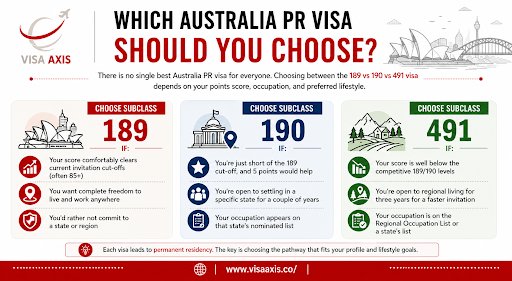
There is no single best Australia PR visa for everyone. Choosing between the 189 vs 190 vs 491 visa depends on your points score, occupation, and preferred lifestyle. For many Indian applicants, the right choice depends on factors such as state demand, career opportunities, and willingness to live in regional areas.
Choose Subclass 189 If:
- Your score comfortably clears current invitation cut-offs (often 85+)
- You want complete freedom to live and work anywhere
- You’d rather not commit to a state or region
Choose Subclass 190 If:
- You’re just short of the 189 cut-off, and 5 points would help
- You’re open to settling in a specific state for a couple of years
- Your occupation appears on that state’s nominated list
Choose Subclass 491 If:
- Your score is well below the competitive 189/190 levels
- You’re open to regional living for three years for a faster invitation
- Your occupation is on the Regional Occupation List or a state’s list
Common Mistakes Applicants Make
Understanding these differences is important, but many applicants still make common mistakes that reduce their chances of receiving an invitation. Avoiding these errors can help you choose the right pathway and prepare a stronger application.
Ignoring State Occupation Lists
Many applicants assume that all states have the same occupation lists as the national list. However, each state has its own requirements and priority occupations. Applying to a state that does not need your occupation can waste time and reduce your chances of receiving a nomination
Selecting the Wrong Visa Pathway
Many applicants focus only on the Skilled Independent visa (subclass 189) because it does not require state nomination. However, this can mean missing better opportunities through the Skilled Nominated visa (subclass 190) or Skilled Work Regional visa (subclass 491). The best pathway is the one that gives you the strongest chance of receiving an invitation.
Missing Invitation Requirements
An outdated points calculation or expired skills assessment can delay your invitation. Learn about the Australia Points Test changes that reshaped scoring under the Australia Points Test 2026 update.
How VisaAxis Helps You Choose the Right Australia PR Visa
Choosing between the 189 vs 190 vs 491 visa pathways can be challenging without proper guidance. At Visa Axis, our expert Australia PR consultant reviews your profile, including your occupation, points score, and migration goals, to identify the most suitable pathway towards Australian permanent residency.
Profile Assessment
We review your points, occupation, and work history to see which visas you’re realistically competitive for.
Skills Assessment & Documentation
Our team directs you to the correct assessing authority and helps prepare accurate documentation, a common cause of delay.
State Nomination & Visa Filing Support
If a 190 or 491 visa pathway is a better fit for your profile, we identify the states that are actively nominating your occupation and manage the entire process, from state nomination to visa filing.
Take the next step with expert Australia PR consultation tailored to your occupation, skills, and points score. Speak with an Australia Immigration consultant to understand your options and choose the right pathway for your PR journey.
Conclusion
The choice between 189 vs 190 vs 491 visa depends on your points score, occupation, and migration goals. The Subclass 189 offers flexibility, Subclass 190 provides state nomination support, and Subclass 491 offers extra points through regional pathways. Understanding these differences can help you choose the right Australia skilled migration pathway based on your profile.
Get expert advice through an Australia PR consultant, understand your options, and Start your Australia PR application with support tailored to your profile.
What is the difference between the 189, 190, and 491 visas?
The main difference between the 189 vs 190 vs 491 visa options is sponsorship and location requirements. The 189 visa does not need sponsorship, the 190 visa requires state nomination, and the 491 visa requires regional nomination or eligible family sponsorship and is a pathway to PR.
Which Australia PR visa is best for Indian applicants?
There is no single best Australia PR visa for Indians. The right choice depends on your occupation, points score, and goals. Some applicants may qualify for the 189, while others may have better chances through the 190 or 491 pathways.
Does the 190 visa require state nomination?
Yes. The Subclass 190 visa requires nomination from an Australian state or territory, and your occupation must meet that state’s requirements.
Can the 491 visa lead to permanent residency?
Yes. The Subclass 491 visa can lead to permanent residency through the Subclass 191 visa after meeting the required regional living, work, and income conditions.
Which visa offers immediate permanent residency?
The Subclass 189 and 190 visas provide permanent residency immediately after approval. The Subclass 491 visa is temporary and can lead to PR later.
Is the points requirement different for 189, 190, and 491 visas?
All three visas use the same points test. However, the 190 visa provides an additional 5 points, while the 491 visa provides an additional 15 points.
Can I move anywhere in Australia with a 491 visa?
No. The 491 visa requires you to live and work in a designated regional area during the provisional visa period.
Which visa has the fastest processing time?
Processing times vary based on factors like occupation and application volume. The 189 may be simpler, as it does not involve state nomination, while the 190 and 491 depend on nomination processes.
Can VisaAxis help me determine the best Australia PR visa?
Yes. As an experienced Australia PR consultant, VisaAxis can review your profile, points, and goals to help you choose the most suitable PR pathway.