Ready to Apply for Australia PR? Step-by-Step Filing Process Without Costly Mistakes
Thousands of Indian professionals dream of moving to Australia, and with good reason. Australia offers world-class healthcare, a stable economy, top universities, and a welcoming multicultural society. But getting there requires careful planning. The Australia PR application process helps you determine whether your journey is smooth or full of expensive setbacks.
This guide breaks down everything you need to know, from eligibility points to documents, fees, and how to avoid common pitfalls. Whether you are just starting out or already in the middle of the process, this blog will give you the clarity you need.
What is an Australian PR Visa? Overview for Indian Applicants
An Australian Permanent Residency (PR) visa allows non-citizens to live, work, and study in Australia. For Indian applicants looking to apply for an Australia PR from India, this is a life-changing step toward better opportunities and a secure future. PR holders can stay in Australia for up to five years, re-enter the country freely, and apply for citizenship after meeting residency requirements.
Understanding the Points-Based Migration System
Australia uses a points-based system to assess skilled workers for permanent residency. If you are planning to apply, it’s important to understand how this system works, as your score directly impacts your chances of selection. The Department of Home Affairs ranks applicants based on a points test, where higher scores increase your chances of receiving an Invitation to Apply (ITA).
Points are given for key factors such as age, English language proficiency, work experience, and education. Each factor adds to your total score, helping determine your position in the selection pool.
- Minimum required score: 65 points
- Competitive score: 80 points or higher
A higher score not only improves your chances but also helps you receive invitations faster.
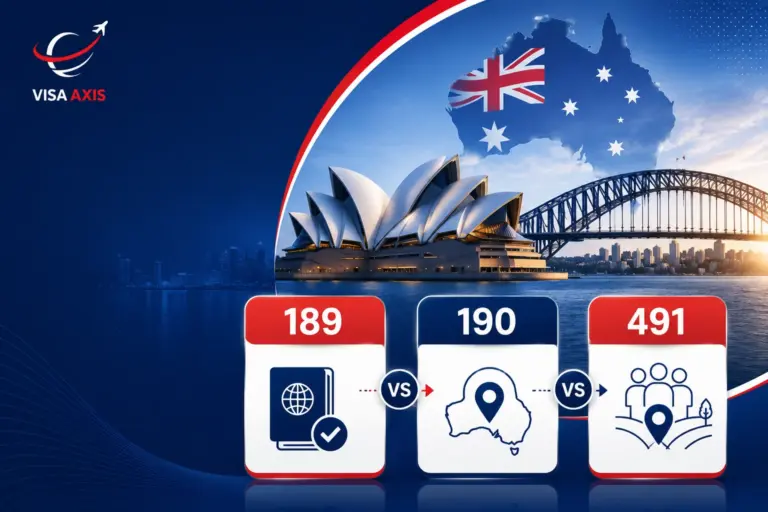
Popular Visa Subclasses: 189, 190, and 491
Australia offers multiple pathways to permanent residency under the General Skilled Migration (GSM) program. The three most popular visa subclasses for Indian applicants are:
- Subclass 189: Skilled Independent Visa: No sponsorship needed. You can live and work anywhere in Australia. Highly competitive cutoffs in IT and engineering often exceed 90+ points.
- Subclass 190: State Nominated Visa: Requires nomination from a state or territory. Adds 5 points to your score. You must live and work in the nominating state for at least 2 years after the visa grant.
- Subclass 491: Skilled Work Regional Visa: A provisional visa leading to permanent residency (Subclass 191). Adds 15 points. You must live in a regional area for 3 years and meet income thresholds before applying for PR.
Choosing the right visa subclass is an important first step. Getting proper Australia PR filing support early helps you avoid costly mistakes later.
Benefits of Securing Australia Permanent Residency
Before starting your application, it’s important to understand what Australian PR offers. It provides the right to live and work in Australia along with long-term security and better career opportunities. Australia PR agents also highlight these benefits to help you make the right decision.
Healthcare (Medicare) and Social Security Benefits
One of the biggest advantages when you apply for an Australia PR from India is access to the Medicare Australia public healthcare system. As a PR holder, you and your family can access government-subsidised medical services, hospital care, and prescription medicines. After a waiting period, PR holders may also become eligible for certain social security benefits, including family tax benefits and child support.
Right to Live, Work, and Study Indefinitely
Australian PR allows you to live, work, and study anywhere in the country without restrictions. Unlike a work visa, where you are required to stay with one employer, a PR visa gives you the freedom to change jobs, switch industries, or even start your own business. When looking for Australia PR application help, this flexibility is one of the main reasons Indian professionals choose this pathway. Children of PR holders also get access to free public schooling and may qualify for government-supported higher education loans.
Australia PR Eligibility & Points Calculator (2026 Update)
If you are working with an Australia PR consultant in India, eligibility assessment is always the starting point. Meeting the base criteria is mandatory before you can even submit an Expression of Interest (EOI). Use the Australia PR Points Calculator to understand where your profile stands before you begin.
Age, Education, and Skilled Employment Criteria
The points you earn depend heavily on three core factors: age, education, and work experience. Here is a quick overview of the 2026 points structure:
| Factor | Points |
| Age (25–32 years) | 30 points |
| Superior English (IELTS 8+ / PTE 79+) | 20 points |
| Australian Master’s or PhD | 5–10 points |
| Overseas Work Experience (8+ years) | 15 points |
| State Nomination (Subclass 190) | 5 points |
| Regional Nomination (Subclass 491) | 15 points |
| Specialist Education Qualification | 10 points |
| Partner with Competent English & Skills Assessment | 10 points |
You must also be under 45 years of age at the time of invitation and have a nominated occupation on the Skilled Occupation List (SOL). An Australia PR filing service can help you identify which category offers the most points for your specific profile.
English Proficiency Requirements (PTE/IELTS)
Australia PR from India requires proof of English via IELTS, PTE, TOEFL iBT, OET, or Cambridge C1 Advanced.
Score Levels:
- Competent English (0 points): IELTS 6.0 in each band; PTE 50 overall.
- Superior English (20 points): IELTS 8.0 in each band; PTE 79+ in each skill.
Tests must be valid (taken within 3 years) at invitation time. Superior scores boost your points for better PR chances.
The Skill Assessment Process Explained
Before submitting your EOI, you must get a positive skill assessment from a recognised Australian authority. This confirms that your qualifications and work experience match your selected ANZSCO occupation. Different bodies assess different professions, such as ACS for IT, Engineers Australia for engineers, and VETASSESS for other roles. PR application help simplifies this and ensures correct document preparation.
Step-by-Step Australia PR Filing Process from India
Now, let us walk through the complete Australia PR filing service process from selecting your occupation to receiving your visa grant.
Step 1: Selecting the Right ANZSCO Occupation
Every Australia PR application journey begins with choosing the correct ANZSCO code. Your nominated occupation must appear on the Medium and Long-term Strategic Skills List (MLTSSL) or the Short-term Skilled Occupation List (STSOL), depending on your visa subclass. An experienced Australia PR consultant India can guide you in selecting the most strategic occupation code for your profile.
Step 2: Obtaining a Positive Skill Assessment
After selecting your occupation, you need to apply to the relevant assessing authority. This process usually takes 2 to 3 months and requires documents like your educational certificates, transcripts, employment references, and pay slips. A positive skill assessment is essential, as you cannot submit your EOI without it.
Step 3: Submitting the Expression of Interest (EOI)
In the Australia PR process from India, once you have your skill assessment and English test results, the next step is to submit your EOI on the SkillSelect portal. This step is free and simple.
You need to enter your points score, choose your visa subclass, and mention if you are open to state or regional options. After submission, your profile is ranked with other applicants based on your points.
Step 4: State/Territory Nomination (Subclass 190 & 491)
If you are applying for a Subclass 190 or 491 visa, you must also apply separately for state or territory nomination. Each state maintains its own occupation list and nomination criteria, which change frequently. An Australia PR filing service that monitors these updates in real time can significantly improve your chances. States like South Australia, New South Wales, Queensland, and Victoria regularly nominate skilled workers in IT, healthcare, engineering, and finance.
Step 5: Receiving the Invitation to Apply (ITA)
If your profile is selected, you will receive an Invitation to Apply (ITA). This means you can now submit your final visa application. You must apply within 60 days of receiving the ITA. If you miss this deadline, the invitation will be cancelled.
Step 6: Visa Lodgment and Document Verification
After receiving your ITA, you submit your visa application through the ImmiAccount portal. The Department of Home Affairs will then check your documents, conduct a medical exam, and verify your Police Clearance Certificate (PCC).
This process usually takes 6 to 12 months. Getting proper Australia PR application help can ensure your documents are correct and help avoid delays.
Documents Required for a Successful PR Application
When you apply Australia PR from India, document accuracy is everything. A missing or incorrect document is one of the most common reasons for refusal.
Identity, Relationship, and Character Documents
- Valid passport with at least 6 months’ validity: Your passport must be current and valid to process your visa and confirm your identity.
- Birth certificate: This document verifies your date of birth and personal identity details.
- Marriage certificate (if applicable): Required to prove your marital status and include your spouse in the application.
- Skills assessment result letter: Confirms that your qualifications and work experience match your nominated occupation.
- English language test results: Show your English proficiency through approved tests like IELTS or PTE.
- Educational certificates and transcripts: Provide proof of your academic qualifications and completed studies.
- Employment reference letters: These letters confirm your job roles, responsibilities, and work duration.
- Pay slips for all claimed work experience: Support your employment claims by showing salary and payment history.
- Police Clearance Certificates: Prove you have no criminal record in countries where you have lived for 12+ months.
- Medical examination results: Confirm that you meet the health requirements set by immigration authorities.
- Proof of funds (bank statements or similar documents): Shows you have enough financial support to settle in Australia.
- Document review by filing service: A professional review ensures all documents are complete, accurate, and meet visa requirements.
Australia PR Cost Breakdown (Fees for Indian Applicants)
Cost is one of the biggest concerns for applicants. Working with the best Australia PR agents means getting complete transparency on every rupee you will spend before you begin.
Visa Application Charges (VAC) for 2026
Before you apply, it’s important to understand the key costs involved in the process. Here is a simple breakdown of the main visa application charges for 2026.
| Category | Cost | Details |
| Visa Application Fee (VAC) | AUD 4,640 (≈ ₹3,00,000) | Paid after receiving ITA |
| Skill Assessment Fee | AUD 500 – 1,450 | Depends on assessing authority |
| English Test (PTE/IELTS) | ₹18,000 | Valid for 3 years |
| Medical Examination | ₹6,000 – ₹8,000 | Done by an approved panel doctor |
| Police Clearance Certificate | ₹500 – ₹2,000 | Per country of residence |
| Consultant / Agent Fees | ₹50,000 – ₹1,50,000 | Optional but recommended |
Knowing these costs in advance helps you plan your budget better and avoid surprises during your visa application process.
How to Avoid Costly Mistakes in Your PR Application
The Australia PR application process is complex, and even small errors can lead to refusal or long delays.
Common Reasons for Visa Refusal
Before submitting your application, it’s important to understand the common mistakes that can lead to visa refusal.
- Incorrect ANZSCO occupation selection: Role does not match your actual work experience
- Overcounting points: Overestimating your score by 5–10 points
- Missing Police Clearance Certificates: Required for all countries lived in for 12+ months
- Outdated English test results: Must be valid at the time of invitation
- Incomplete employment references: Missing letterheads, wrong dates, or unclear duties
- Missing the 60-day ITA deadline: No extensions allowed
An experienced Australia PR filing service reviews your application carefully before submission. This helps reduce errors and improves your chances of approval
Why Hire Visa Axis as Your Australia PR Consultant in India?
Choosing the right Australia PR consultant in India is important for a smooth and successful process. Visa Axis is a trusted name, helping Indian professionals successfully migrate to Australia with expert guidance and reliable support.
Expert Filing Services & Document Review
Get complete, step-by-step support to make your Australia PR process simple and stress-free.
- Complete support from eligibility check to final visa approval
- Accurate points calculation and profile evaluation
- Correct ANZSCO code selection and skill assessment guidance
- EOI submission and state nomination strategy support
- Full document preparation and 60-day ITA submission assistance
- Post-approval guidance to help you settle in Australia
With the right support and a clear process, you can move forward with confidence and improve your chances of a successful PR outcome.
Conclusion
Australia offers one of the world’s most structured and merit-based immigration systems. With the right Australia PR application help, the path from India to Australia is more achievable than many people realise. The key is to start early, calculate your points accurately, and work with an experienced team that knows the system inside out.No matter which visa pathway you choose, Subclass 189, 190, or 491, each step needs to be handled carefully. Connect with our Australian immigration experts at Visa Axis for clear guidance on the next steps.
FAQs
How long does the Australia PR process take from India in 2026?
The total Australia PR filing service timeline from start to finish is typically 12 to 18 months. This includes skill assessment (2 to 3 months), SkillSelect waiting period (variable by occupation and score), and visa processing after ITA (6 to 12 months). Applicants with stronger point profiles and complete documents tend to experience faster processing.
What is the minimum points required for Australia PR?
The minimum score to apply for Australia PR through the EOI system is 65 points. This makes you eligible to enter the pool. However, for high-demand occupations like IT and accounting, most invitations are given to candidates with 85 to 100+ points. A higher score increases your chances of receiving an ITA faster.
Can I apply for Australia PR without an agent?
Yes, technically, you can apply Australia PR from India without using an agent. However, given the complexity of the process, multiple documents, strict deadlines, and non-refundable fees, most applicants benefit significantly from working with the best Australia PR agents. Even a single document error can result in visa refusal and a significant financial loss.
Is PTE better than IELTS for Australian PR?
Both PTE Academic and IELTS are accepted for Australia PR from India. The main difference is speed. PTE results usually come in 2–5 days, while IELTS takes about 13 days. In terms of PR points, both tests are equal. So, choose the one you feel more comfortable with.
What are the total costs involved in Australia PR filing?
For a single applicant, the total cost is usually around ₹4,00,000 to ₹6,00,000. This includes visa fees, skill assessment, English test, medical exam, police clearance, and professional service charges. If you are applying with family, the cost will increase for each additional member. Also, visa fees paid to the government are non-refundable.
Which state in Australia is easiest to get PR?
For Subclass 190 and 491 visas, states like South Australia, Tasmania, Northern Territory, and the Australian Capital Territory are often easier to get a nomination from. They usually have lower point requirements and more flexible occupation lists. However, the best state depends on your profile, including your occupation, points score, and where you are willing to live. Getting guidance from an Australian PR consultant in India can help you choose the right option.