Canada PR Rejection: Top Reasons Why Indian Applications Get Refused & How to Fix It
Receiving a Canada PR refusal after months of planning and preparation can be disappointing, but it does not mean your immigration journey is over. In many cases, the reasons behind a rejection are simple mistakes that can be identified and corrected.
This guide explains the most common Canada PR rejection reasons India applicants face, why these refusals happen, and the practical steps you can take to fix the issues and improve your chances of success in your next application.
Key Takeaways
- This blog will help you understand the most common Canada PR rejection reasons, including mistakes in NOC selection, reference letters, and proof of funds.
- It will show how even small document or profile mismatches can lead to refusal under strict IRCC checks.
- It will explain why most rejections are not permanent and how you can reapply after fixing errors.
- It will highlight the importance of correct language scores, ECA, and consistent documentation for a successful application.
- It will guide you on how missing deadlines or IRCC requests can directly impact your application outcome.
- It will also explain how GCMS notes can help you identify the exact reason for rejection and improve your next attempt.
The Reality of Canada Immigration Rejection India Trends
Canada PR rejections for Indian applicants are increasing because IRCC now checks applications more carefully using automated screening systems before manual review. Even small mistakes in documents like your NOC code, reference letter, ECA, or language test results can lead to a refusal. As a result, more applicants are facing Canada PR rejection reasons India, Canada immigration rejection India, and express entry refused India cases. In many situations, these refusals happen because of common documentation errors or missing information that can be corrected before reapplying.
How IRCC’s High-Volume Automation Systems Audit Indian Applications
Canada receives a very large number of Express Entry applications every year. To manage this, IRCC uses automated systems in GCMS (Global Case Management System) to quickly screen files before an officer reviews them. If there is any mismatch in your NOC code, employer letter, ECA, or language score, the system can flag your application early. Many Indian profiles get flagged when job duties are too general or do not clearly match the NOC description.
Because of stricter rules after 2023, Canada immigration rejection India cases have increased, and officers now have very little flexibility when documents are unclear or inconsistent.
Why a Rejection is Not a Permanent Ban: Understanding Refusal vs. Inadmissibility
A rejection usually means your application did not meet IRCC’s requirements, but it is not always permanent. In most cases, you can correct the issue and apply again. A serious eligibility issue is more severe and can happen because of problems like misrepresentation, criminality, or certain medical concerns, which may lead to a temporary or longer ban. Most Canada PR rejection reasons India cases are refusals, so applicants often still have a chance to reapply.
Top 8 Canada PR Rejection Reasons India Profiles Encounter
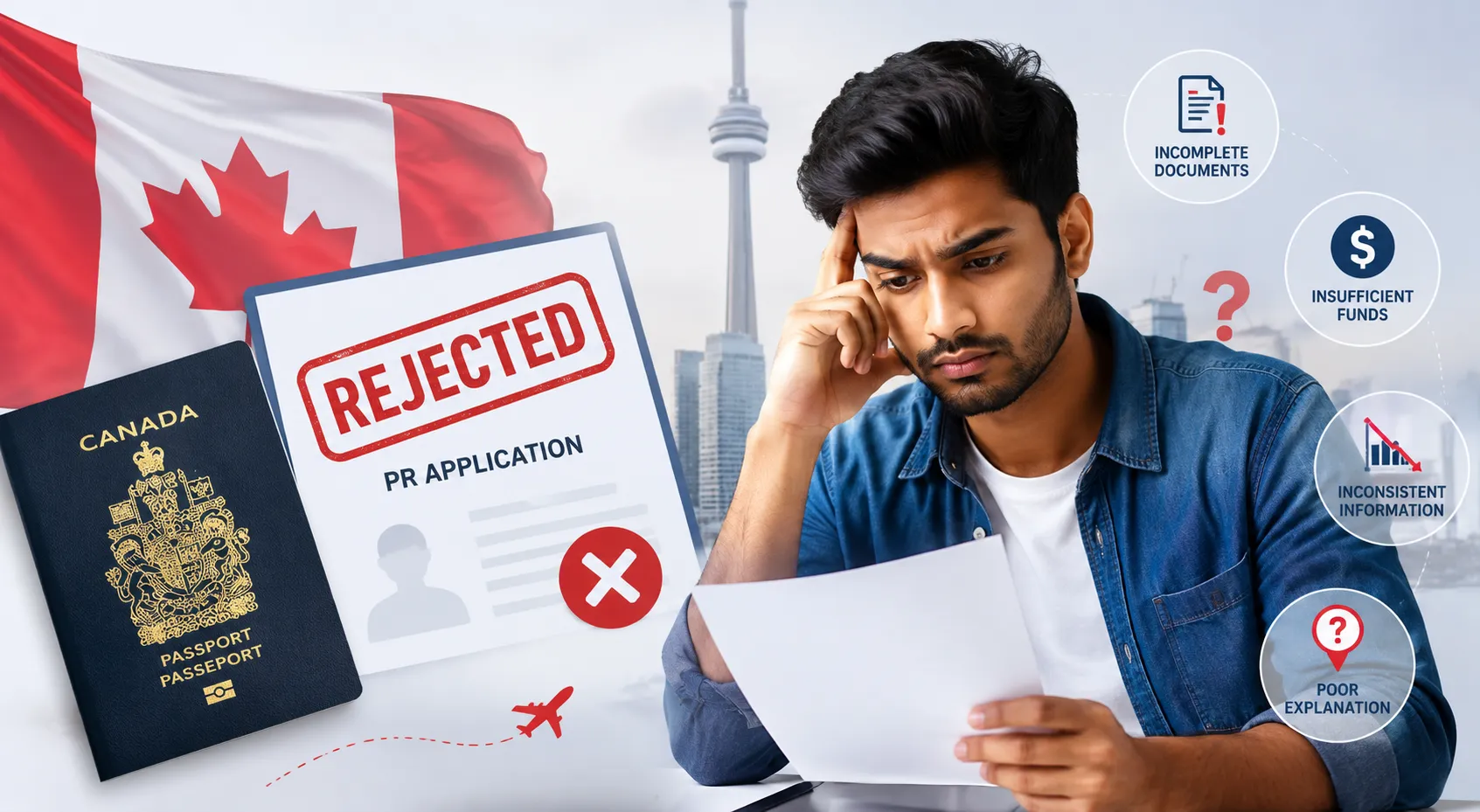
Many Canada immigration rejection India cases happen due to avoidable documentation errors, eligibility mismatches, or missed procedural requirements. Understanding these issues in advance helps applicants build a stronger and more accurate Express Entry profile.
1. Incomplete or Mismatched Work Reference Letters Under Express Entry
The most common reason for Express Entry refused India cases is a work reference letter that does not match the NOC job duties. IRCC expects the letter to clearly show your employment details and responsibilities.
- Be on official company letterhead with contact details
- Include job title, employment dates, salary, and working hours
- Clearly list job duties that match the NOC description
Many Indian applicants submit only basic HR letters that confirm employment but do not include duties. IRCC carefully compares your duties with the NOC list, and even small mismatches can lead to refusal.
Fix: Get a detailed letter matching the NOC duties. If your employer cannot provide it, submit a notarized declaration along with payslips, appraisal letters, and project documents.
2. Insufficient or Volatile Proof of Funds (POF) Documentation
IRCC requires proof you can support yourself and your family after landing. For Canada immigration rejection India cases linked to funds, the common errors are:
| Issue | Why IRCC Rejects It |
| Balance appears only at statement end | Looks like a temporary deposit |
| Funds from a third-party account | IRCC questions ownership |
| Statements older than 6 months | Considered stale |
| No consistent savings pattern | Raises credibility concerns |
Fix: Maintain the required POF amount for at least three months before submission. Use one bank account, avoid large last-minute transfers, and submit a bank-certified statement.
3. Sectional Language Score Expiries and Low Core Component Points
IELTS and CELPIP scores are valid for only two years. If your scores expire between your EOI submission and ITA processing, your application can become ineligible, leading to Express Entry refused India cases. This is a common technical reason for refusal.
Low scores in individual sections like speaking or writing can also reduce your overall CRS points and affect competitiveness. Most successful candidates aim for CLB 9 in all four components to improve their chances.
Fix: Always check your score validity at each stage. If your scores are close to expiry and you have not received an ITA, retake the test in advance.
4. Unintentional Misrepresentation and Section 40 Violations
Section 40 of IRPA deals with misrepresentation, and it applies even if the mistake was not intentional. It is one of the serious reasons behind why Canada visa refused India cases.
Common triggers include:
- Not declaring previous visa refusals (tourist, study, or work)
- Job title not matching the claimed NOC code
- Missing or undeclared dependents or spouse
- Education details not matching ECA results
A Section 40 finding can lead to a five-year ban from applying again. Officers do not need to prove intent for this to apply.Fix: Always declare full and accurate information, including past refusals, dependents, and travel history. If unsure, disclose it. A professional RCIC or immigration lawyer can help review your file before submission.
5. Ineligibility Due to Wrong NOC/TEER Code Alignment
Canada now uses the TEER system instead of the old NOC 2016 classification. However, many Indian applicants still select outdated or incorrect codes, which is one of the common Canada PR rejection reasons India. If the TEER code does not match your actual job duties, your application may be considered ineligible.
Only TEER 0, 1, 2, and 3 occupations are generally eligible under Express Entry, while TEER 4 and 5 are not. Even if your job title sounds similar, eligibility depends on your actual responsibilities. Fix: Always use the latest 2021 NOC TEER system on the IRCC website and match your work experience based on your duties rather than just your job title.
6. Failing the Strict Medical Admissibility Standards
All applicants and their family members must complete an Immigration Medical Examination (IME) before getting Canada PR. Incomplete medical reports or health conditions that may place a high burden on Canada’s healthcare system can result in refusal.
IRCC carefully reviews all medical records submitted during the application process, and missing the IME for even one family member can affect the entire application. Fix: Complete medical exams for all family members together and ensure the approved panel physician submits the results directly to IRCC.
7. Complex Background Checks and Criminal Inadmissibility Flaws
Many Canada immigration rejection India cases happen because of problems during background verification. Common issues include expired or missing Police Clearance Certificates (PCCs), undeclared criminal charges, or arrests and detentions that were not disclosed in the application.
If you have lived or worked in another country, such as the UAE, UK, Australia, or the USA, you may also need a PCC from that country.
Fix: Obtain PCCs from every country where you have lived for six months or more since turning 18, and disclose all relevant legal matters, even if the case was minor or later dismissed.
8. Missing Strict Deadlines for Critical IRCC Requests for Information (RFI)
After receiving an Invitation to Apply (ITA), you have 60 days to submit your complete application. IRCC may also send a Request for Information (RFI) asking for additional documents, and you usually have only 30 days to respond. Missing these deadlines, even by one day, can result in your application being refused. Many applicants miss important updates because they do not regularly check their IRCC account or emails.
Fix: Log in to your IRCC account frequently after submission, monitor your email inbox and spam folder, and set reminders for every important deadline.
Explore: How work visas can lead to Canada PR
The Troubleshooting Guide: How to Deal with an Express Entry Refused India Profile
An Express Entry refusal is not the end of your Canada PR journey. The key is to understand the exact reason for refusal and fix the gaps before reapplying, instead of submitting the same profile again.
Ordering and Decoding Your IRCC Global Case Management System (GCMS) Notes
GCMS (Global Case Management System) notes are the internal records used by IRCC officers to review and process immigration applications. You can request these notes through an Access to Information and Privacy (ATIP) request, which costs $5 and usually takes 30 to 90 days. They explain the exact reason for refusal, highlight missing or weak documents, and include any concerns related to medical or Section 40 issues.
Many express entry refused India applicants skip this important step and submit a new application without understanding why the first one was rejected. Reviewing your GCMS notes first helps you fix the real issues and improves your chances of success in the next application.
Re-Evaluating Your Comprehensive Ranking System (CRS) Matrix Conservatively
After a refusal, review your CRS score carefully using the Express Entry CRS Points Calculator 2026. Make sure your language test results are still valid, your work experience matches the latest TEER requirements, and your ECA accurately reflects your educational qualifications. Checking these details can help prevent another refusal.
Re-aligning Your Academic and Financial Dossier for a Second Attempt
Before submitting a new application, update all your documents and review them carefully. Get fresh work reference letters, updated proof of funds statements, and a new ECA if your educational credentials have changed. Every document should be complete, accurate, and consistent because IRCC officers examine them closely during the review process.
Strategic Remedies: Moving Past Your Canada Immigration Rejection India
A Canada immigration rejection India decision does not always mean your Canada PR journey is over. In many cases, you can improve your profile, fix the issues that caused the refusal, and submit a stronger application.
When to Choose a Judicial Review vs. Filing a Brand New EOI Application
A Judicial Review (JR) is an option when you believe IRCC made a legal or procedural error while processing your application. It is not a new assessment of your PR eligibility but a review of whether the decision was made fairly. For most why Canada visa refused India cases caused by missing documents or profile mistakes, submitting a new and corrected application is usually the best option. A Judicial Review is generally considered only if you believe IRCC made an unfair decision or failed to follow the proper legal process.
Leveraging Provincial Nominee Programs (PNPs) to Bypass Prior Express Entry Blocks
If your Express Entry profile is weak because of a low CRS score or a previous refusal, a Provincial Nominee Program (PNP) can provide another pathway to permanent residence. Provinces such as Ontario, British Columbia, and Alberta have streams that select eligible candidates based on local labour market needs. A provincial nomination adds 600 CRS points to your profile, greatly increasing your chances of receiving an Invitation to Apply (ITA). This makes PNPs a valuable option for many Indian applicants looking to strengthen their PR prospects.
Why Legal Navigation Eliminates Structural Application Risks
Proper legal guidance helps reduce mistakes in documentation, eligibility checks, and application filing, which are common reasons for delays or refusals. It also ensures your profile is aligned with current immigration rules and reduces the risk of structural errors in your application.
Overcoming Complex Profile Rejections with the VisaAxis Strategy Team
Fixing a refused Canada PR application without professional guidance can be difficult. Immigration rules change regularly, and even small mistakes can lead to another refusal. Expert guidance can help identify the issues and improve your next application.VisaAxis supports Indian applicants with complex profiles, previous refusals, and international work experience. The team includes experienced RCICs who can help with Canada PR rejection reasons India cases by reviewing your profile, improving your documents, and preparing a stronger reapplication strategy.
Conclusion
A Canada PR rejection reasons India outcome does not mean your Canada PR journey is over. In many cases, refusals happen because of simple mistakes like an incorrect reference letter, the wrong NOC code, an expired language score, or missing documents. By checking your GCMS notes, understanding the reason for refusal, and fixing the issues, you can prepare a stronger application and improve your chances of success.
If you need expert guidance, Visa Axis can help you review your profile, prepare accurate documents, and choose the right strategy for reapplication. With careful planning and complete documentation, you can improve your chances of Canada PR success.
FAQs
What are the most common Canada PR rejection reasons India applicants face?
The most common reasons include choosing the wrong NOC code, incomplete work reference letters, insufficient proof of funds, expired language test scores, and missing or inconsistent documents. These mistakes can often be corrected before reapplying.
How long do I have to wait if my profile gets express entry refused india?
In most cases, there is no mandatory waiting period after an express entry refused India decision. Once you fix the issues that caused the refusal, you can prepare and submit a new application.
Will a previous tourist refusal cause my profile to be Canada immigration rejection India?
A previous tourist visa refusal does not automatically lead to Canada immigration rejection India. However, you must declare all past refusals honestly, as failing to disclose them could lead to misrepresentation.
My file was rejected due to a funds issue, why Canada visa refused India exactly?
Your application may be refused if your proof of funds does not meet IRCC requirements or if the money appears inconsistent or borrowed. Maintaining the required balance and providing proper bank documents can help avoid this issue.
Can I edit a submitted document before an official Canada immigration rejection in India occurs?
After submission, you generally cannot edit uploaded documents yourself. If IRCC requests additional information or documents, you can provide updated files within the given deadline.
Does an error by an IRCC officer ever mimic standard Canada PR rejection reasons India?
Yes, although it is uncommon, an officer may make a legal or procedural error during assessment. In such cases, you may consider requesting a Judicial Review if there is evidence that the decision was unfair or unreasonable.