Germany PR After Opportunity Card: Timeline & Steps
Many skilled professionals struggle to turn their Opportunity Card into permanent residence in Germany. While finding a job is the first milestone, the real goal for most applicants is long-term stability through permanent residence. The Opportunity Card lets you enter Germany and search for jobs, but it does not directly lead to permanent residence. Instead, it acts as a stepping stone toward a work permit or Blue Card, which is where your actual PR timeline begins.
However, getting Germany PR after an Opportunity Card is possible if you follow the right steps.
This guide breaks down everything you need to know about Germany PR and the step-by-step process to help you move smoothly from an Opportunity Card to permanent residence in Germany.
Can You Get Germany PR After Opportunity Card?
You can get Germany PR after the Opportunity Card, but it does not happen directly. The Opportunity Card is a job-seeker residence permit, not a permanent or settlement permit. Its main purpose is to help skilled professionals enter Germany legally and find suitable employment that can later lead to permanent residence.
What the Opportunity Card Allows
With an Opportunity Card, you can:
- Live in Germany legally during the job search period
- Search for a qualified and skilled job matching your profile
- Work part-time while looking for full-time employment
- Prepare to transition to a long-term work residence permit
How You Become Eligible for Germany PR
To qualify for Germany permanent residence, you must first convert your Opportunity Card into a work-based residence permit. Only time spent on these permits counts toward your PR timeline.
You become eligible by:
- Securing a job in Germany
- Converting the Opportunity Card into a German work permit or EU Blue Card
- Completing the required residence period on the work permit or Blue Card
The Opportunity Card itself does not count toward permanent residence, but it is the first step that allows you to enter Germany and start the PR pathway.
How the Opportunity Card Leads to Permanent Residence in Germany
The Opportunity Card serves as a starting point for skilled professionals who want to settle permanently in Germany. While it does not offer permanent residence directly, it allows you to enter Germany legally and begin the process of long-term integration through employment and contribution.
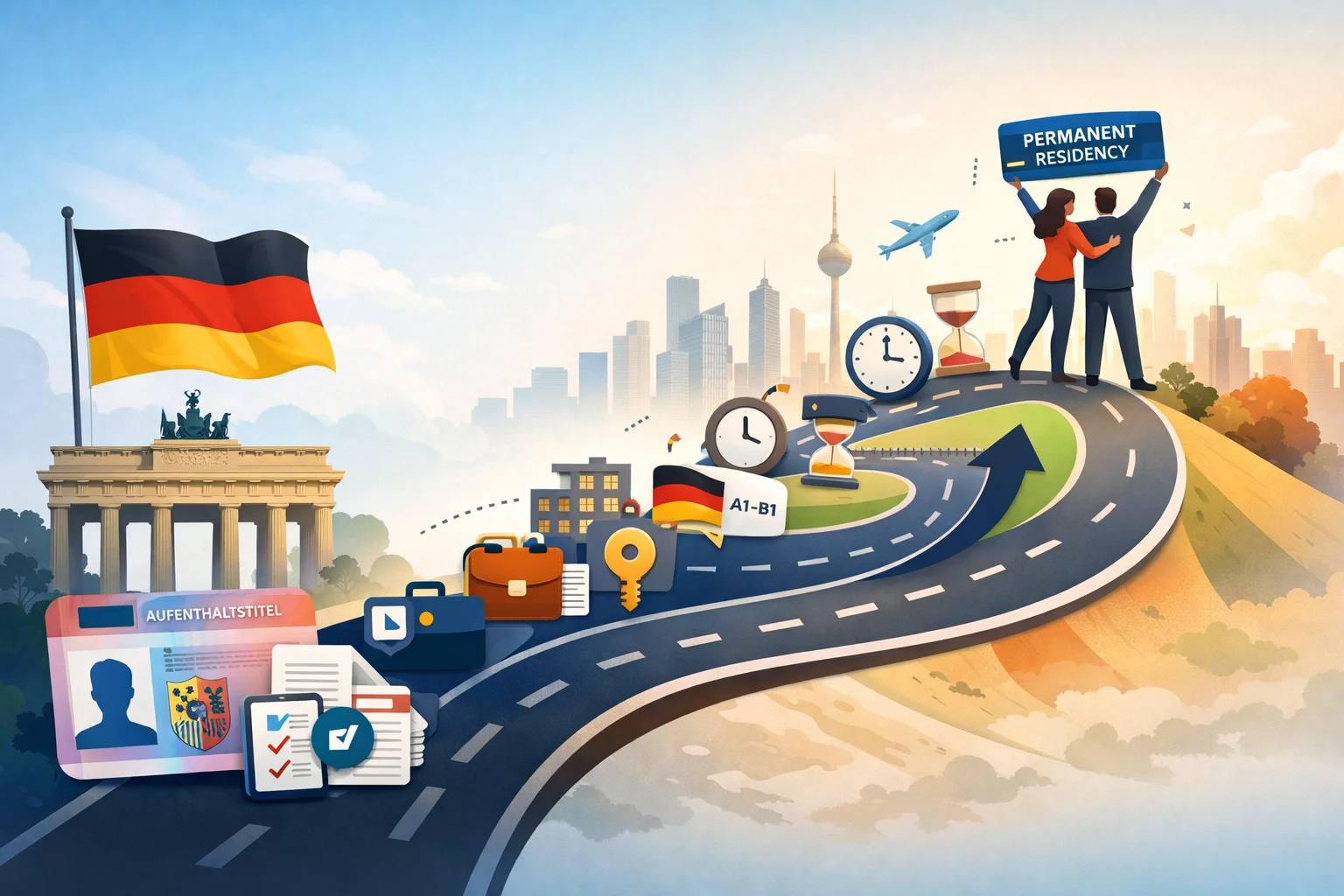
Step-by-Step Progression to Germany PR
- Opportunity Card (Job Search): This card allows you to reside in Germany and search for a skilled job that suits you.
- Skilled Job: Once you get a good job, that will be your long-term stay in Germany.
- Work Permit or EU Blue Card: You have to convert the Opportunity Card to a German work permit or an EU Blue Card. This is important as only work-based permits assist you in acquiring permanent residence.
- Continue Living and Integrating: You have to continue working when you are here, pay taxes, invest in a pension scheme, learn German, and obey all the regulations of immigration.
- Permanent Residence (PR): Once you have stayed for a certain period and you have satisfied the integration requirements, you become eligible to apply for permanent residence in Germany.
Through this clear route, permanent residence in Germany after the Opportunity Card becomes achievable and straightforward, depending on your job stability, consistent contributions, and how well you adapt to life in Germany.
Explore: Blocked Account Germany
Step-by-Step Path: Opportunity Card to Germany PR
The path from the Opportunity Card to Germany PR follows a clear, step-by-step process. By securing a skilled job, switching to a work permit or EU Blue Card, and meeting residence requirements, you can move steadily toward permanent residence in Germany.
Step 1: Enter Germany on the Opportunity Card
The Opportunity Card allows you to enter Germany for up to 12 months to look for a skilled job. This period is meant only for job searching and preparing for long-term employment.
During this time, you can:
- Attend job interviews
- Network with employers
- Work part-time (up to 20 hours per week)
- Explore different cities and industries
It is important to understand that this stage is not permanent residence, not a long-term work visa, and does not guarantee PR. However, it is the first and most important step toward Germany PR after the Opportunity Card, as your next progress depends on finding a qualified job.
Step 2: Secure a Qualified Job
This is the most important step in your journey toward Germany PR after Opportunity Card. To move forward, you must find a skilled job that matches your education and work experience.
Your job should:
- Match your qualifications
- Be recognized as skilled employment in Germany
- Meet minimum salary requirements (especially for the EU Blue Card)
Skilled roles such as engineering, IT, healthcare, science, and technical positions qualify for PR. Unskilled or casual jobs do not count. Securing the right job is essential because permanent residence is only possible after skilled employment.
Step 3: Convert Opportunity Card to Work Permit
After securing a skilled job, you must convert your Opportunity Card to a work permit or EU Blue Card to start your Germany PR after Opportunity Card journey. This step is crucial because only time on a work-based permit counts toward permanent residence.
Failing to convert on time can break your residence continuity, delay your PR timeline, or cause visa issues. Early conversion ensures a smooth and faster path to German PR.
Step 4: Work & Pay Taxes in Germany
This phase determines whether you meet the core Germany permanent residence requirements. Immigration authorities closely evaluate your stability and contributions during this period.
You must demonstrate:
- Continuous and lawful employment
- Regular income tax payments
- Mandatory pension contributions
- Valid health insurance coverage
- Stable and registered accommodation
Any long employment gaps, unpaid taxes, or missing pension contributions can delay or weaken your Germany PR after Opportunity Card application. Consistency and compliance are key factors for approval.
Step 5: Apply for Permanent Residence (PR)
After meeting all duration, employment, and integration requirements, you can apply for the Permanent Residence Permit (Niederlassungserlaubnis).
This permit allows you to:
- Live in Germany indefinitely
- Work without restrictions or permit renewals
- Change employers freely
- Access the social security benefit
- Apply for German citizenship in the future
Once granted, permanent residence provides long-term security and completes your journey from Opportunity Card to a settled life in Germany.
Germany PR Timeline After Opportunity Card
Your Germany PR timeline depends on the type of residence permit you hold after starting work. Faster routes, like the EU Blue Card, can significantly shorten the waiting period.
Minimum Years Required for PR
The time to PR depends on your permit and German skills. Blue Card holders qualify fastest.
Check this breakdown:
| Residence Type | PR Eligibility Time |
| Standard Work Permit | 5 years |
| EU Blue Card | 33 months |
| Blue Card + B1 German | 21 months |
| Blue Card + A2 German | 27 months |
Choosing the EU Blue Card can reduce your PR waiting period by more than half.
Fast-Track PR Options (EU Blue Card Route)
The EU Blue Card is the fastest and most reliable route to Germany PR after Opportunity Card. Once you secure a high-skill job that meets the salary requirements, switching to a Blue Card can significantly shorten your permanent residence timeline.
Key advantages of the EU Blue Card include:
- Accelerated PR timeline, allowing you to apply for PR much sooner than a standard work permit
- Lower pension contribution requirements, making PR eligibility easier
- Faster family reunification, with fewer restrictions for dependents
- Stronger job mobility, giving you more flexibility to change employers
For most skilled professionals in Germany, choosing the EU Blue Card after the Opportunity Card is the smartest and most efficient strategy for achieving permanent residence.
Germany Permanent Residence Requirements
Meeting Germany’s permanent residence requirements is essential to get approval and secure long-term residency. Fulfilling all conditions ensures a smoother PR process and faster eligibility.
Employment & Salary Requirements
You must show:
- Ongoing skilled employment
- Salary above minimum thresholds
- No reliance on public welfare
Salary levels vary by profession and permit type.
Language Requirements (A2 / B1 German)
Language proficiency is a major factor.
- A2 level: Standard PR eligibility
- B1 level: Faster PR and stronger approval chances
Language skills demonstrate integration and long-term intent.
Pension Contributions
Pension contributions are a key Germany permanent residence requirement. You must show regular pension payments through legal employment in Germany, while EU Blue Card holders benefit from reduced contribution periods for faster PR eligibility.
Clean Criminal & Immigration Record
To qualify for Germany PR after Opportunity Card, you must have:
- No serious criminal convictions
- No immigration violations
- No visa overstays
Compliance builds trust with immigration authorities.
Explore: Germany Transit Visa for Indian Travellers Guide
Opportunity Card vs Blue Card: Which Leads to PR Faster?
This comparison clearly shows that the Opportunity Card helps you enter Germany, while the EU Blue Card provides a faster and more direct path to permanent residence.
| Factor | Opportunity Card | EU Blue Card |
| Purpose | Job search | Skilled employment |
| Direct PR Path | No | Yes |
| PR Timeline | Indirect | Fast-track |
| Salary Requirement | No | Yes |
| Family Benefits | Limited | Strong |
The Opportunity Card helps you enter Germany, but the Blue Card helps you stay permanently.
Documents Required for Germany PR Application
When applying for Germany PR after the Opportunity Card, it is important to have all required documents prepared and organized in advance. Having complete and accurate paperwork not only speeds up the application process but also reduces the risk of delays or rejections.
- Valid passport
- Current residence permit
- Employment contract
- Salary slips (last 6–12 months)
- Pension contribution proof
- Health insurance certificate
- German language certificate
- Rental agreement
- Tax payment records
Incomplete or missing documents are one of the most common reasons applications get delayed, so double-check everything before submission to ensure a smooth and timely approval process.
Germany PR Processing Time
The Germany PR processing time depends largely on your location and the workload of local immigration authorities in Germany. While some applications are processed quickly, others may take longer due to regional demand. On average, you can expect the following timeline for Germany PR approval.
Average Processing Timeline
- 3 to 6 months in most cities
- Up to 9 months in high-demand regions
Early preparation can significantly reduce Germany PR processing time.
Factors That Delay PR Approval
Many Germany PR applications are delayed due to simple and avoidable mistakes. Understanding these issues early helps you prepare properly and get faster approval in Germany.
The most frequent causes of PR delays are:
- Lost or unfinished documentation, such as pay slips, pension documents, or rental agreements.
- Inadequate pension payments, and this is particularly where you had a small period of service or had gaps.
- Issues with language certificates, including the fact that they are outdated or of the necessary level.
- Unemployment, which makes individuals concerned about their financial situations.
- Applying before fulfilling the eligibility criteria, such as the length of residence in the country.
Avoiding these mistakes, maintaining proper records, and applying only when fully eligible can significantly speed up PR approval and reduce the risk of rejection.
Common Mistakes That Delay Germany PR
Many applicants unintentionally delay Germany PR after the Opportunity Card by misunderstanding how the process works. Being aware of these common mistakes can help you plan better and avoid unnecessary setbacks in Germany.
Common mistakes include:
- Assuming Opportunity Card time counts fully toward permanent residence, when in reality, only work-based permits are counted
- Delaying the conversion from an Opportunity Card to a work permit or EU Blue Card after getting a job
- Ignoring German language preparation, which can slow down PR eligibility and approval
- Changing jobs without notifying immigration authorities leads to compliance issues
- Applying without meeting Germany’s permanent residence requirements, such as pension contributions or residence duration
With strategic planning, timely permit conversion, and proper preparation, these errors can be easily avoided, helping you reach Germany PR faster and with fewer complications
How VisaAxis Helps You Get Germany PR After Opportunity Card
VisaAxis provides complete support for Germany PR after the Opportunity Card, including application guidance, job search help, Blue Card conversion, and document verification. Their expertise makes the process smoother and increases your chances of approval.
- Opportunity Card application
- Job search strategy guidance
- Work permit & Blue Card conversion
- PR eligibility assessment
- Document verification
- Application filing support
Professional assistance significantly improves success rates for Germany PR after Opportunity Card.
Conclusion
Getting Germany PR after Opportunity Card is possible with proper planning. By converting your Opportunity Card to a work permit or EU Blue Card on time and meeting all Germany permanent residence requirements, you can smoothly progress to permanent settlement in Germany.For expert guidance on Germany PR, trust VisaAxis to help with visa conversion, document preparation, and a smooth PR application process.
FAQs
Q1. Can I get Germany PR after Opportunity Card?
Yes, absolutely, you just need to convert your Opportunity Card to a work permit or EU Blue Card first. After a few years of steady work, taxes, and settling in, PR is on the table. Many Indians make this jump successfully every year.
Q2. How long does it take to get PR in Germany after Opportunity Card?
Typically, 3-5 years from when you start working full-time. EU Blue Card speeds it up to as little as 21 months if you’ve got a B1 German. Regular permits take the full 5 years.
Q3. Is Opportunity Card better than Blue Card for PR?
Not for PR speed, the Opportunity Card helps you enter and find jobs, but the Blue Card gets you there faster once employed. Pick Opportunity if job hunting; Blue Card if you have an offer ready.
Q4. What are the requirements for Germany permanent residence?
You need 3-5 years of skilled work, pension contributions, B1 German (or A2 for shortcuts), health insurance, and no legal issues. Clean record and financial stability seal the deal.
Q5. What is the processing time for Germany PR?
Processing time for Germany PR is 2-4 month as average, but major urban areas can extend it to 8 months, such as Munich. Send hardcopy papers to eliminate time lapses in your local office.
Q6. Does German language affect PR approval?
Definitely, B1 German cuts your wait time in half and shows you’re integrating. Without it, you’re stuck on longer timelines and weaker approval odds.
Q7. Can family members get PR with me in Germany?
Yes, spouses and kids can apply after you get PR, if they meet language/integration rules too. It’s straightforward family reunification once you’re settled.