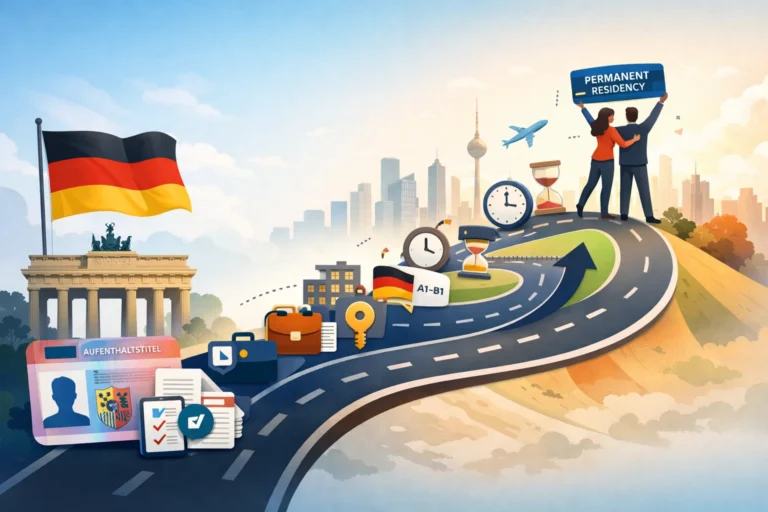
Top In-Demand Jobs Eligible for Germany Skilled Worker Visa
Germany welcomes thousands of skilled Indian professionals every year because of its strong job market and balanced work-life culture. As the demand for talent continues to grow, the Germany skilled worker visa process becomes easier and quicker for an applicant-friendly experience from start to finish.
This guide covers all the key details, including eligibility, documents, and major job opportunities, helping you apply for the visa confidently.
What is the Germany Skilled Worker Visa?
The Germany Skilled Worker Visa allows qualified professionals with recognised education or work experience to take up full-time employment in Germany. It is specifically designed for skilled individuals who can support industries facing talent shortages, giving them access to strong career opportunities.
This visa offers a clear and stable long-term pathway. It allows workers to obtain residence rights, change jobs when needed, and later apply for permanent residency. Overall, this is an excellent choice for professionals looking for stability, growth, and a better future abroad.
Eligibility Criteria for Germany Skilled Worker Visa
To qualify for the Germany skilled worker visa, applicants must meet certain requirements set under the German skilled worker immigration act. The requirements can vary by occupation, but here are the common ones for most Indian applicants:
- A recognised degree, vocational qualification.
- Evidence of work experience (typically 1-2 years)
- A genuine job contract or an offer from a German employer.
- Communication skills (English or German, based on the position).
- Evidence of meeting skilled worker visa salary requirements in Germany.
- Health insurance and a clean background record.
For example, the IT professionals might not require knowledge of the German language at the first stage, whereas healthcare employees usually require a minimum of the B1 or B2 level of German. When these criteria are fulfilled, candidates will be able to proceed with the application process easily.
Difference Between Skilled Worker Visa and Other Work Visa Types
Many applicants are confused about the Germany skilled worker visa with general work visas. However, the key difference lies in eligibility. Skilled worker visas are strictly for applicants with recognised qualifications, whereas general work permits may accept other job categories.
Here’s what makes the skilled worker visa look unique:
- It gives preference to qualified professionals
- It leads to quicker permanent residency pathways
- It supports family reunification
- It usually requires higher salary standards
- It offers stronger career stability
This visa is ideal for individuals who want long-term professional growth and access to better working conditions in Germany.
Are you a doctor? Check out: Doctor Jobs in Germany
Top In-Demand Jobs Eligible for Germany Skilled Worker Visa
Germany has found that there are a number of occupations in which the skilled labour shortfall is particularly extreme. From engineering to healthcare, these industries have continued to provide full-time and part-time job opportunities with thousands of openings for qualified Indian candidates every year.
IT and Software Development Jobs
IT continues to be one of the hottest fields for the Germany skilled worker visa. German companies are rapidly expanding their digital operations, leading to an urgent need for developers, cybersecurity experts, analysts, and cloud engineers.
Popular IT roles include:
- Software developers: Software developers create, develop, and support applications and systems that serve the fast-growing digital and automation industries of Germany.
- Data analysts: Data analysts transform mass data into digestible insights to enable firms to optimise performance and make sound decisions.
- AI engineers: AI engineers design machine learning applications and intelligent systems that have applications in robotics, automotive technology, and advanced research.
- DevOps professionals: The DevOps professionals enhance interaction between the development team and the IT team to enhance quick deployments and seamless operations of the system.
- Cloud architects: Cloud architects create secure, scalable cloud technology that assists in digital transformation in all industries.
- Cybersecurity specialists: Cybersecurity experts can protect networks, systems, and sensitive information against rising cyber threats in the online German environment.
The German online economy is growing, and it is expected that it will grow by over 20 percent in 2026. This offers long-term dependable chances. The IT professionals with good English can secure employment without the core competence skills in German.
Healthcare Professionals
Healthcare is considered one of the industries where the shortage of workforce is the highest. The Germany skilled worker visa can be applied for by nurses, caregivers, physiotherapists, and lab technicians as long as their qualifications are recognised.
Job options include:
- Registered nurses
- Medical technicians
- Radiology assistants
- Physiotherapists
- Elderly care specialists
Healthcare roles usually require German language skills (B1 or higher). The good salary, benefits, and career growth make these jobs a great option for many professionals. Many hospitals also support new staff by offering language training.
Engineering and Technical Jobs
Engineering roles continue to lead Germany’s job market, and companies are actively hiring Indian professionals through Germany skilled labour visas from India, offering strong opportunities across fields like automotive and renewable energy.
Top engineering specialisations include:
- Mechanical engineering: In Germany, mechanical engineers work in the conception, analysis, and upgrading of machinery production systems and industrial equipment, especially in the automotive and manufacturing sectors.
- Civil engineering: Civil engineers are hired to manage the infrastructure development, such as roads, bridges, railways, and commercial buildings, to sustain the growing urbanisation of Germany.
- Electrical engineering: Electrical engineers work in power generation, automation, energy supply, and electronics, and it is among the most in-demand skills in Germany.
- Mechatronics: Mechatronics professionals work in the sphere of mechanical systems, electronics, and automation, namely robotics, manufacturing, and smart factory.
- Industrial engineering: Industrial engineers are necessary because they have to optimize the manufacturing process and minimize the quantity of waste materials, and make the manufacturing process more efficient. Hence, it is inevitable to have them as a part of the developed manufacturing environment in Germany.
- Automotive engineering: Automotive engineering is an important field in the international automobile industry or Germany, which is responsible for the design of cars, testing, electric vehicles, and technology.
Germany is the country that is home to global engineering giants and is also a good choice for professionals who want hands-on experience and long-term job security.
Skilled Trades and Other Occupations
Beyond the technical and healthcare sectors, numerous skilled trades and other occupations are also in high demand in Germany.
- Electricians: Electricians in Germany are involved in the installation, repair, and maintenance of electrical systems in homes, businesses, and industries and are therefore imperative in various industries.
- Plumbers: The plumbers are sought to install and maintain water supply, drainage, heating systems, and sanitation structures in the growing construction sector in Germany.
- Carpenters: Carpenters deal with woodwork, structural installations, and furniture constructions.
- Welders: Welders work in manufacturing, construction, and metal fabrication, and their job is done using advanced forms of welding techniques, which are applied throughout the engine industries of Germany.
- Fitters: Fitters are workers who install, assemble, and maintain mechanical parts and systems, particularly in factories, workshops, and heavy machinery set-ups.
- Machine operators: They are the machine operators and controllers of the industrial machines in the production lines in Germany, so that there will be an expedited and smooth running of the automated production facilities in Germany.
- Chefs and hospitality staff: As the country has an amazing growth in tourism and food industries, hence, there is also a great demand for chefs and hospitality employees in the restaurants, hotels, and catering services.
These jobs are recognised under the German skilled labour visa for Indian applicants, and this makes it easier to get stable jobs, and soon you may also get a visa for residence.
Also Read: How to find a job in Germany!
Germany Skilled Worker Visa Requirements
To apply, every Indian applicant must meet the Germany work visa requirements for Indians, even though the exact criteria can change based on the job field.
Documentation Required for Indian Skilled Labour Visa
Here are the key documents usually required for a Germany skilled worker visa:
- Valid passport
- Job offer or employment contract
- Proof of qualifications (degree, diploma, apprenticeship)
- Recognition certificate from German authorities (if required)
- Updated CV
- Proof of experience
- Salary proof meeting visa guidelines
- Health insurance
- Proof of funds
- Completed visa application form
Always double-check the document through official German portals or with a professional consultant like Visa Axis to avoid mistakes.
Language and Qualification Recognition
For the Germany skilled worker visa, language and skill recognition are essential. Some jobs accept English speakers, but roles involving public interaction require good German skills.
Qualification recognition ensures your degree matches German standards. Engineers, IT specialists, and healthcare workers often go through this process before approval. Getting recognition early speeds up your visa timeline and makes it easier for employers to evaluate your profile.
Explore: PR in Germany for Indians: Pathways, Eligibility & More
How to Apply for Germany Skilled Worker Visa: Step-by-Step Guide for Indian Applicants
Applying for the Germany skilled worker visa involves a series of steps. Here is a simple breakdown:
Step 1: Check Eligibility
Make sure that your occupational qualification is recognised and your job offer is within the salary requirement. To proceed with the application, ensure that your position is in an approved list of skilled occupations.
Step 2: Gather All Documents
Gather all your education documents, work experience documents, passport documents, and financial documents. You will also need your updated resume and work contract, and in the case of any language tests, show the certificates as well. Ensure that all the documents are of a recent date and are properly scanned.
Step 3: Apply for Qualification Recognition
This move is essential to healthcare, engineering, and technical positions. It attests that your degree/training is equivalent to German standards to enable you to work legally in your area.
Step 4: Secure a Job Offer
There are various German firms that engage in aggressive recruitment of Indian employees via job portals or recruitment drives. A confirmed job offer is also a faster way to process your visa, as it will show that you fit the criteria of a skilled position.
Step 5: Book Your Embassy Appointment
Present your papers at the German Embassy or German Consulate in India. Remember to book your appointment early enough before space is filled, since the slots are filled quickly, particularly during high months. Bring all the original photocopies, and ensure that you check your file twice to be sure that you do not face any last-minute problems during the verification process.
Step 6: Attend the Visa Interview
Be prepared to explain your job, qualification background, and work experience. In general, the interview will be about what you have done in your career, with whom you are going to work in Germany, and also your plans for your career. During the discussion, stay calm, speak clearly, and have all the necessary documents to back up your answers.
Step 7: Wait for Processing
It must be processed in between 8-12 weeks, and this depends on your job type and document accuracy. The embassy can reach out and request further details; thus, you need to monitor your mail. This waiting time should be used to get ready for your move, researching housing, and learning basic German etiquette.
Step 8: Move to Germany and Go to Work
Once you do this, you can travel to Germany, complete your local registration, open a bank account, and get your health insurance activated. These steps are useful in helping you to settle easily and start your new job with confidence.
Following these steps helps applicants avoid delays and simplifies the entire journey.
Benefits and Challenges
To help you make an informed decision, here’s a quick look at the key advantages and potential challenges of the Germany Skilled Worker Visa.
- Long-term job stability
- High salaries and social security
- Pathways to permanent residency
- Family reunification options
- Access to the European work culture
However, there are many other challenges for applicants, such as language requirements, strict documentation, and housing in German cities. Preparing beforehand can help you to easily deal with these hurdles.
Conclusion
The Germany skilled worker visa is a great choice for Indian professionals looking for stable careers and global opportunities. If you have recognized qualifications and the necessary skills, and you are willing to adapt to a different work culture, this visa can help you drive long-term growth and secure employment in Germany.
If you need expert guidance, connect with Visa Axis today!
FAQs
Q1. What are the most in-demand jobs for the German skilled worker visa in 2025?
The German skilled worker visa is largely in the field of IT occupations, healthcare, renewable energies, and skilled trades that are going to be in high demand in the year 2025. This includes things like software developers, nurses, mechanical engineers, wind energy technicians, and electricians.
Q2. What specific documents do Indian skilled workers need to apply for this visa?
Indian skilled workers require a legitimate employment opportunity, a degree or qualification documentation, a certificate of qualification recognition, a passport, bank statements, insurance documentation, and filled application forms. Other requirements might involve accommodation and police clearance certificates for some of the applicants.
Q3. Is German language proficiency mandatory for the skilled worker visa?
Proficiency in the German language is not a prerequisite, but employment involving the IT industry can be done using English, particularly in multinational firms. The professional norms usually require the application of at least B1 of German in the health care and most of the skilled professions. Learning German is beneficial in order to live and be a part of everyday life.
Q4. How long does the Germany skilled worker visa process take for Indian applicants?
The visa application process for Indian skilled workers typically occupies 8 to 12 weeks. The schedule can be based on the job type, and in case all the documentation is valid and properly filled out, delays can occur only in case of document concerns or if extra verification is required.
Q5. Can family members accompany skilled workers on this visa?
Family members can join skilled workers through a family reunification visa. The primary applicant must show sufficient income and accommodation for dependents. Documents like marriage or birth certificates are required for family members.