Why Subclass 491 is the Best Pathway to Australia PR in 2026
The Australia Subclass 491 visa in 2026 is an important option for skilled workers who can’t apply for direct PR. It offers benefits like lower points and regional job opportunities, but also has limits, such as living in regional areas and following strict rules.
This guide will explain the 491 visa, its pros and cons, and show you step-by-step how to plan your Australian PR journey.
What is the Australia Subclass 491 Skilled Work Regional Visa?
The Australia Subclass 491 PR pathway starts with a points-based regional visa. You need a state nomination or regional family support and must live and work in regional areas for up to 5 years. After meeting work and income rules, you can get permanent residency through Subclass 191.
Definition: The Skilled Work Regional (Provisional) visa (Subclass 491) is a 5-year visa that lets skilled workers and their families live, work, and study in regional Australia. It gives you the chance to gain local work experience and settle in regional areas, with a clear pathway to permanent residency later.
Key features of the 491 skilled visa Australia:
- 5‑year provisional visa with a clear regional focus.
- You must live, work, and study only in designated regional areas (most of Australia except major cities like Sydney, Melbourne, and Brisbane, with some policies excluding hubs such as the Gold Coast or Perth in certain programs).
- Requires either state/territory nomination or eligible regional family sponsorship.
- Points tested with a minimum of 65 points in the Australia PR points calculator 2026.
- Provides a structured PR route via subclass 191 once you meet the 3‑year residence and taxable income rules.
The 491 visa is a good option for Indians working in IT, engineering, healthcare, trades, or teaching. Experts like Visa Axis can guide you and help you avoid mistakes.
How Does the Australia Subclass 491 PR Pathway Lead to Subclass 191 PR?
The 491 to 191 PR process lets you turn a temporary regional visa into permanent residence. In the first 3 years, live in a regional area, earn the required income, and follow visa rules to qualify for Subclass 191 PR.
Eligibility Requirements for the 491 to 191 PR Process
To move from the 491 to the 191 visa, you need to:
- Hold a 491 (or similar regional) visa for at least 3 years.
- Live and work only in designated regional areas during that time.
- Earn the required taxable income for at least 3 years (check the current amount on the official site).
- Follow all visa rules, like living and working in regional areas.
- Meet health, character, and other standard PR requirements.
Subclass 491 to Subclass 191: Simple PR Progression Stages
Follow these stages carefully to move smoothly from a provisional 491 visa to permanent residency through the 191 visa.
| Stage | Visa | Key goal | Minimum period |
| Stage 1 | Subclass 491 | Live and work in regional Australia on a provisional visa. | Up to 5 years, with 3 years needed. |
| Stage 2 | Subclass 191 | Secure permanent residency after meeting the income and stay rules. | Apply after 3 qualifying years. |
Step-by-Step 491 to 191 PR Process for Indian Applicants
Here’s a clear roadmap to move from a Subclass 491 visa to permanent residency under Subclass 191 for Indian applicants:
- Get a 491 visa through state nomination or regional family sponsorship.
- Move to the nominated regional area and start full-time skilled work.
- Keep records each year, like tax returns, payslips, employment contracts, and proof of regional address.
- After 3 years of meeting the income requirement, prepare and submit your Subclass 191 application.
- Wait for your PR decision.
If you don’t meet the income or regional rules in a year, it can delay your PR. Jobs in nursing, allied health, software, engineering, and trades often pay enough to meet the requirements.
Explore: Australia PR Process from India
What Are the 2025–2026 Updates for Regional Visa Australia and Subclass 491?
In 2025–2026, the regional visa Australia 2026 is a good option if you are willing to live outside Sydney, Melbourne, and Brisbane. Most cities outside these three are considered regional.
Latest 2025–26 highlights
- Most locations outside Sydney, Melbourne, and Brisbane are treated as regional for migration benefits.
- Popular cities for the 491 visa include Adelaide, Perth, Hobart, Canberra, Darwin, and the Gold Coast.
- States regularly invite skilled workers for 491 visas, mainly for in-demand occupations.
How Can Indians Qualify for Australia State Nomination Under Subclass 491?
Most Indians use Australia state nomination rather than family sponsorship. To qualify, you must meet federal 491 rules and state requirements. Key points include:
- Your occupation must be on the state’s skilled list.
- Minimum 65 points (75+ for competitive jobs).
- Under 45 years old and competent in English.
- Meet any state work, study, or regional residency rules.
State highlights:
- NSW: Focuses on IT, engineering, healthcare, and teaching, and prefers applicants already in regional NSW (North South Wales).
- South Australia: Invites skilled workers in healthcare, engineering, trades, agribusiness, and education, with good options in Adelaide and smaller regions.
- Victoria & WA: Focus on state priority jobs, graduates, and regional links; suitable for professionals with regional experience.
Visa Axis can help you with the Australia state nomination for Indians by guiding you to the states with the best chances.
How Does the Australia PR Points Calculator 2026 Affect Your Subclass 491 Chances?
The Australia PR Points Calculator 2026 is important for the Subclass 491 because this visa is fully points-based. You need at least 65 points to apply, but competitive profiles usually score 75–90+, especially in jobs like software engineering and accounting.
Main factors affecting points:
- Age: Maximum 30 points, this is because ages 25-32 are the highest scorers.
- English: 20 points are allowed on high IELTS or PTE scores.
- Education: PhD, 15 points bachelor, less than 15 points diplomas, trades.
- Work experience: Overseas and Australian experience (normally 15 to 20 points).
- Other factors: Partner skills, Australian study, specialist education, or community language.
State nomination or family sponsorship gives extra points and makes the 491 visa easier. Check your points on the official Australia PR points calculator.
Sample age points (illustrative):
- 18–24: mid-20s points
- 25–32: highest, around 30 points
- 33–39: slightly lower
- 40–44: around 15 points
- 45+: no points
To increase scores, many Indians retake English tests, study in regional areas, or add partner skills. Experts like VisaAxis can review your score and suggest actions, like skill upgrades or state choices, to make your profile more competitive.
Also Read: Employer-Sponsored Visa Australia Complete Guide
How Should Indians Plan Their Skilled Work Regional Visa (Subclass 491) Strategy in 2026?
For Indian professionals, the 491 visa should be treated as the first step toward PR. Picking the right job, points score, and state makes it easier to meet the 3-year work and income rules for Subclass 191.
Step‑by‑step planning approach:
- Use a 2026 PR points calculator to check where you stand today.
- Match your occupation with regional demand lists in 1–2 target states such as NSW, South Australia, Victoria, or WA.
- Decide whether you are better placed as an onshore (student/graduate, TSS holder) or offshore applicant.
- Improve your English score and, if needed, consider further study or certification that fits regional demand.
- Map out a 3‑year regional work plan that can reasonably keep your taxable income above the 191 threshold.
How can Indians choose the right regional state for 491?
Once you choose the right state, the next step is aligning your points, skills, and documents to maximise your 491 invitation chances.
- Match your occupation with state demand, not just the easiest nomination rules.
- Check which states actively invite your ANZSCO occupation.
- Look at real job opportunities in regional areas, not only migration lists.
- Consider lifestyle factors like climate, cost of living, and community support.
- Prefer states where you can realistically live and work for 3 years.
What mistakes should Indians avoid in the 491 PR pathway?
Avoiding these mistakes early makes the Subclass 491 journey smoother and keeps your long-term PR goals on track.
- Choosing a regional course without checking if the related occupation is on the skilled list.
- Assuming any regional job is enough, without meeting income or skill requirements.
- Ignoring state nomination updates and invitation rounds for long periods.
- Changing jobs or locations without checking the 491 visa conditions.
- Not planning early for the move from Subclass 491 to Subclass 191 PR.
What Is the Step‑by‑Step Australia Subclass 491 PR Process for Indians?
Here is the step‑by‑step Australia Subclass 491 PR pathway from India given below-
- Eligibility and points check: Test your age, English score, education, and work experience. Ensure that you get 65 points or above.
- Select your job and skills assessment: Apply to the appropriate assessing authority to get a positive skills assessment by selecting your ANZSCO occupation.
- Pick 1–2 regional states: Compare state occupational lists and regulations. Select those states where your job is needed.
- Place your Expression of Interest (EOI): Select the states you wish to be nominated in in SkillSelect and provide SkillSelect with accurate information.
- Secure state nomination or family nomination: Nominate individually to the state, or have an eligible regional family sponsor.
- Reside and work in Australia, regionally: Reside in designated geographical locations, become lawful, and have documentation of your earnings.
- Apply for PR (Subclass 191): After 3 years of living and working in the region, apply to receive Subclass 191 to obtain permanent residency.
Visa Axis will help you with key steps like skills assessment, EOI planning, choosing the right state, and making sure your 3-year records meet 191 PR rules.
What Is the 2025–2026 Industry Context for the Australia Subclass 491 PR Pathway?
In 2025–2026, Australia is encouraging skilled workers to move to regional areas. Because of this, the 491 visa is a popular pathway to PR through the 191 visa. Indian professionals have good job chances in health, education, tech, and infrastructure.
Key points:
- South Australia and Victoria have issued many skilled invitations under 190 and 491 visas.
- The government supports regional settlement and filling local skill gaps.
- Regional employer sponsorship is now easier and faster.
- Graduates in regional areas get longer post-study work rights.
- Choosing regional jobs gives better chances than crowded city options.
Regional visas are now a popular and realistic path for building careers in hospitals, schools, and regional industries.
Explore: Australia 600 Visa Processing Time
How Does the Australia Subclass 491 PR Pathway Compare with Other Australia PR Options?
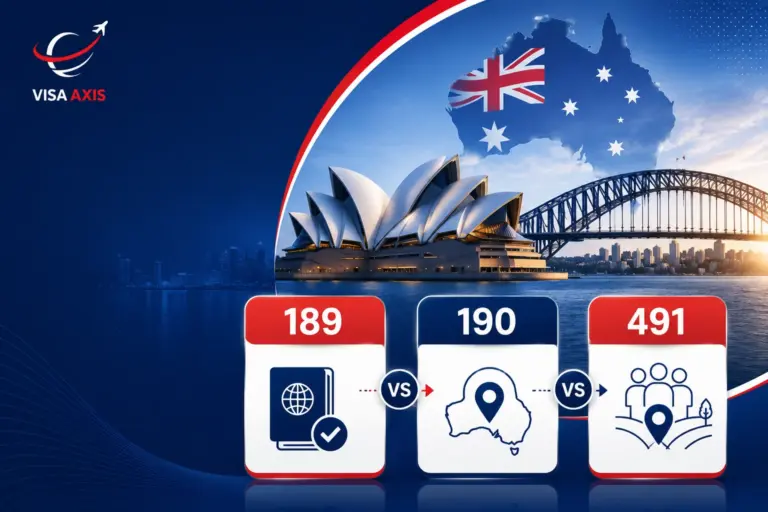
The Australia Subclass 491 PR pathway gives better chances of getting an invitation than the Subclass 189 or 190. You need to live in regional areas and apply for PR later through Subclass 191. It’s a good option for Indians who can be flexible about location and want a clear path to PR.
Key differences between the main skilled PR pathways:
| Aspect | Subclass 189 | Subclass 190 | Subclass 491 PR pathway |
| Type | Permanent. | Permanent. | Provisional leading to PR through Subclass 191. |
| Nomination | Not required. | State/territory. | State/territory or eligible regional family. |
| Location | Anywhere in Australia. | State‑specific (metro and regional). | Regional areas only. |
| Points | Usually highest competition. | High competition. | Often more accessible with nomination/sponsorship points. |
| PR outcome | Direct PR for the grant. | Direct PR for the grant. | PR after 3 years and 191 approval. |
Many skilled Indians in 2026 choose the 491 visa when their 189 or 190 options are limited by points or job caps. The best visa depends on your goals, comfort with risk, and willingness to live in regional areas.
Conclusion
The Australia Subclass 491 PR pathway in 2026 is a valuable option for skilled Indian professionals. It offers work opportunities in regional areas and a clear path to Subclass 191, providing an easy route to Australian permanent residency.
Start your Australia PR journey with Visa Axis for expert guidance and a smooth, fast pathway to PR.
Is Subclass 491 easier than 189 and 190?
Yes, 491 is usually easier to get because you get extra points for regional/state or family sponsorship, so cut‑offs are often lower than 189 and sometimes 190. But 189/190 are direct PR, while 491 is a temporary regional visa with conditions.
How long to get PR after 491?
You first hold 491 (up to 5 years), live and work in regional Australia for at least 3 years, and meet the income requirement. After that, you can apply for PR through Subclass 191, so many people get PR in about 3–5 years.
Can Indians apply for 491 without a job offer?
Yes, Indians can apply without a job offer if they have the required points, skills assessment, English, and a state or eligible family sponsor. Some states prefer or reward applicants with job offers, but it is not always compulsory in the main visa rules.
Which states invite Indians under 491?
States that commonly invite offshore Indians for 491 include South Australia, Tasmania, regional New South Wales, regional Queensland, regional Western Australia, and sometimes the Northern Territory (depending on year and quotas). Each state changes its occupation list and rules regularly, so you must check the latest criteria before applying.
Is regional Australia safe for Indian migrants?
Most regional cities like Adelaide, Hobart, and other key centres are generally safe, family‑friendly, and less crowded than big metros. There can be occasional racist incidents anywhere, but many regional areas now have growing Indian communities and student populations that offer support.
What is the minimum income requirement for 491 (for PR)?
To later get PR (Subclass 191), you must earn at least a minimum taxable income amount (linked to a government threshold like TSMIT) for 3 years while on 491. The exact figure can change, so you must check the current amount and keep proper tax records for those 3 years.
Can I move to big cities after getting PR from 491?
While on 491, you must live, work, and study only in designated regional areas, not in major cities like Sydney, Melbourne, or Brisbane. After your 191 PR is granted, regional conditions end, and you can live anywhere in Australia.
What if I don’t meet regional stay conditions?
If you do not live and work in regional areas or do not reach the required income for 3 years, you usually cannot apply for 191 PR via the 491 pathway. Serious or deliberate breaches of conditions can also affect future visas and, in some cases, risk visa cancellation.
Is 491 good for IT professionals?
Yes, many IT jobs are on the skilled lists and used by states for 491 when 189 invitations are limited or need very high points. For Indian IT professionals ready to work in regional areas, 491 is a practical pathway to gain experience and then apply for PR via 191.
Why is Australia focusing on regional visas in 2026?
Australia wants migrants to help grow smaller cities and towns, not only Sydney, Melbourne, and Brisbane, to reduce pressure on housing and services. Government planning for 2025–26 shows more places for regional visas like 491 to fill skill gaps and support regional economies.