Canada PR After Study Visa: PGWP to PR Pathway for Indian Students (2026 Guide)
For thousands of Indian students, studying in Canada is not just about earning a degree it is the first step toward building a permanent future. The PGWP to PR Canada pathway allows international graduates to gain Canadian work experience and transition toward permanent residency. If you are planning your journey from a Canada study visa to PR, understanding the right steps early can help you avoid delays and make informed decisions.
This guide will help you understand the complete post-graduate work permit to PR process, including 2026 eligibility requirements, timelines, required documents, PR pathways, and practical tips to improve your chances of securing Canada PR after graduation.
Key Takeaways
|
What Is the PGWP to PR Pathway in Canada?
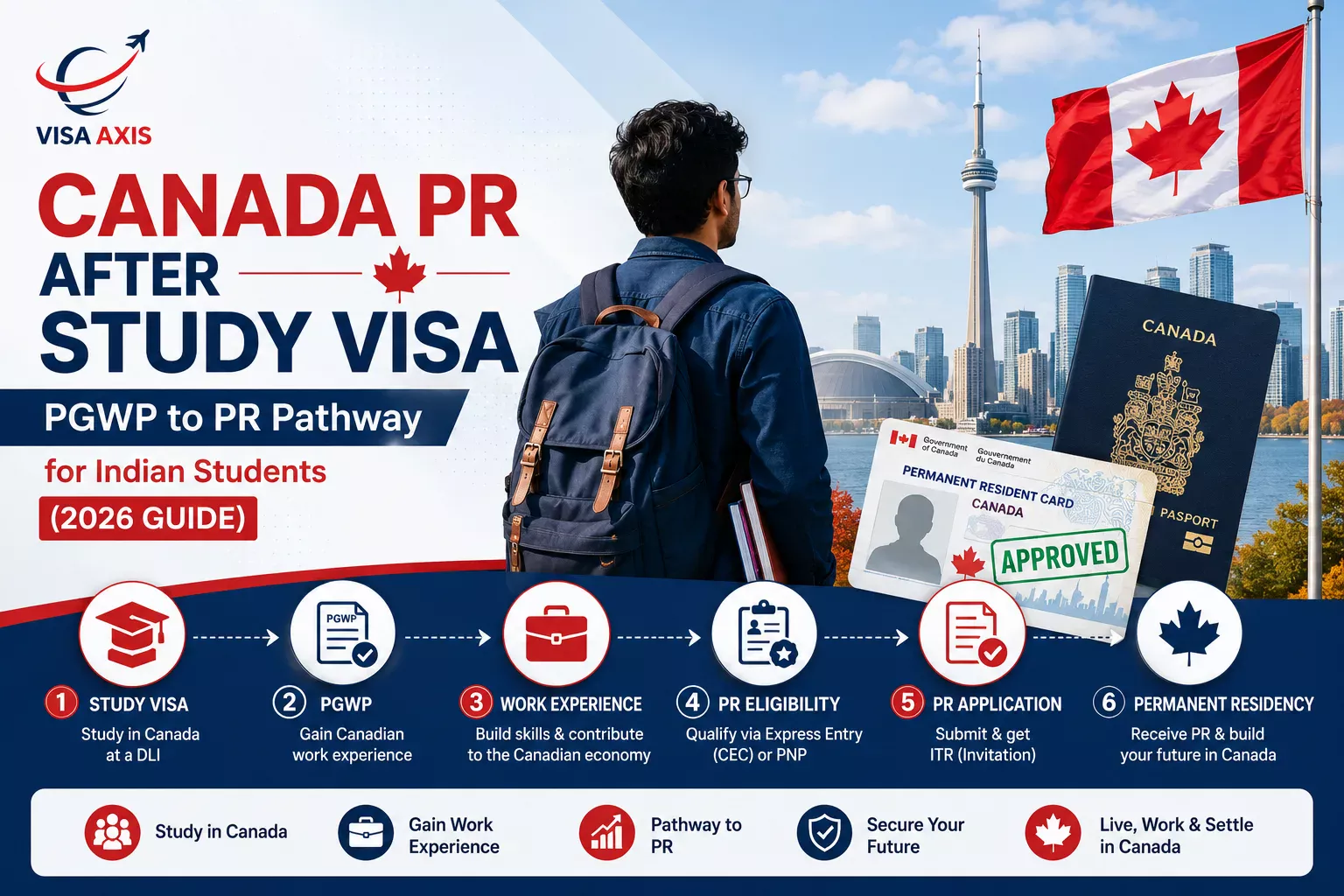
The PGWP to PR Canada pathway is the process that helps international graduates move from temporary status to permanent residence. After completing your studies in Canada, you can apply for a Post-Graduation Work Permit (PGWP), gain skilled Canadian work experience, and then apply for PR through Express Entry (Canadian Experience Class) or a Provincial Nominee Program (PNP).
The journey usually follows these steps:
- Study at a PGWP-eligible Canadian institution.
- Graduate and apply for your Post-Graduation Work Permit.
- Gain at least 12 months of skilled Canadian work experience.
- Apply for permanent residence through Express Entry or a PNP.
Every year, more than 100,000 former international students become permanent residents, with Indian students making up one of the largest groups. The PGWP to PR Canada pathway gives graduates a strong advantage because Canadian education and work experience can significantly improve their PR prospects.
Why Canada Encourages International Graduates to Stay
Canada values international graduates because they already have Canadian education, work experience, and a good understanding of the country’s job market and culture. As a result, they often find it easier to settle, contribute to the economy, and fill labour shortages. This is one of the main reasons Canada PR after graduation remains a popular option, with immigration programs giving graduates a strong advantage when applying for permanent residence.
Benefits of Moving from Study Permit to Permanent Residency
Moving from a Canada study visa to PR offers several advantages for Indian students. You can stay in Canada while applying for permanent residence, earn extra points for Canadian education and work experience, and improve your chances through Express Entry or provincial programs. Once you become a permanent resident, you can also sponsor eligible family members, enjoy greater job flexibility, and build a long-term future in Canada.
What Is a Post-Graduation Work Permit (PGWP)?
A Post-Graduation Work Permit (PGWP) is an open work permit given to graduates of eligible Canadian institutions. It allows you to work for almost any employer in Canada without needing a job offer or employer sponsorship. For most international students, the PGWP is the first major step in the post-graduate work permit to PR journey because it helps you gain the Canadian work experience required for permanent residency.
Who Is Eligible for a PGWP?
To qualify for a Post-Graduation Work Permit (PGWP), you must:
- Graduate from a PGWP-eligible Designated Learning Institution (DLI).
- Complete a full-time program that is at least 8 months long.
- Apply within 180 days of receiving your program completion confirmation.
- Meet the required language level (CLB/NCLC 7 for university graduates and CLB/NCLC 5 for most college or diploma graduates).
- Not have received a PGWP before, as it is issued only once.
Keep in mind that not all institutions are PGWP-eligible. Most public colleges and universities qualify, but many private colleges do not. Always check a school’s Designated Learning Institution (DLI) and PGWP eligibility before enrolling.
How Long Is a PGWP Valid?
The length of your Post-Graduation Work Permit (PGWP) depends on the duration and type of program you complete. The table below shows the typical PGWP validity based on your course of study
| Program Length | Typical PGWP Duration |
| Less than 8 months | Not eligible |
| 8 months to under 2 years | (e.g., 9‑month program → up to 9‑month PGWP) |
| 2 years or more | Up to 3 years |
| Master’s degree (any length) | Up to 3 years |
Your PGWP also cannot extend beyond your passport’s expiry date, so renewing your passport before applying is essential. Calculate your Canada PR score now to see how many points you have and what you can improve to get an Invitation to Apply.
How Indian Students Can Transition from PGWP to Canada PR
The PGWP to PR Canada pathway typically involves four simple steps that help international graduates transition from studying in Canada to becoming permanent residents.
Step 1: Complete an Eligible Canadian Program
Your Canada study visa to PR journey begins by completing a PGWP-eligible program at a recognized Designated Learning Institution (DLI). For college and diploma programs, your field of study may affect eligibility, while bachelor’s, master’s, and PhD graduates are generally exempt from these restrictions.
Step 2: Obtain Your PGWP
Apply for your Post-Graduation Work Permit (PGWP) within 180 days of receiving your final transcript or completion letter. This permit allows you to gain Canadian work experience, making it a key step in the PGWP to PR Canada pathway.
Step 3: Gain Canadian Skilled Work Experience
After graduation, gain at least 12 months of full-time (or equivalent part-time) skilled work experience in a NOC TEER 0, 1, 2, or 3 occupation. Work completed while studying, including co-op placements, generally does not count toward PR eligibility.
Step 4: Apply Through Express Entry or PNP
Once you meet the required work experience and language requirements, you can apply for permanent residence through Express Entry or a Provincial Nominee Program (PNP), depending on which option best matches your Canada PR eligibility.
Best PR Pathways After PGWP
There are several options within the PGWP to PR Canada pathway, and the best choice depends on your Canadian work experience, province, occupation, and CRS score. Understanding these pathways can help you choose the route that best matches your Canada PR eligibility.
Canadian Experience Class (CEC)
The Canadian Experience Class (CEC) is the most popular PR pathway for PGWP holders. To qualify, you generally need at least 12 months of skilled Canadian work experience within the last three years, meet the required language level (CLB 7 for TEER 0/1 jobs or CLB 5 for TEER 2/3 jobs), and plan to live outside Quebec.
Provincial Nominee Programs (PNPs)
Provincial Nominee Programs (PNPs) allow provinces and territories to nominate skilled workers based on local labour needs. A provincial nomination gives you an additional 600 CRS points, greatly increasing your chances of receiving an Invitation to Apply (ITA) for permanent residence.
Express Entry for International Graduates
Express Entry manages the Canadian Experience Class (CEC) along with other federal immigration programs. Most international graduates apply through this system after gaining eligible work experience. While CRS cut-off scores vary with each draw, category-based draws for occupations such as healthcare, STEM, trades, and French-language candidates may have lower score requirements.
Province-Specific Graduate Streams
Several provinces, including Ontario, British Columbia, Manitoba, and Saskatchewan, offer dedicated immigration streams for international graduates. These programs provide an additional pathway to permanent residence, especially for graduates who meet the province’s labour market needs.
Eligibility Requirements for Canada PR After Study
Before applying, it helps to check where you stand against the core eligibility pillars of the PGWP to PR Canada pathway.
| Requirement | Typical Standard |
| Education | Eligible DLI credential (diploma, degree, or postgraduate program) |
| Language | CLB 7 (TEER 0/1) or CLB 5 (TEER 2/3) in IELTS/CELPIP or TEF/TCF |
| Canadian work experience | Minimum 12 months, full-time, skilled (TEER 0–3), post-graduation |
| Proof of funds | Required if you don’t have qualifying arranged employment |
| Admissibility | Clean police clearance, valid medicals, no misrepresentation |
Education Requirements
To apply through the PGWP to PR Canada Pathway, you must complete an eligible program from a PGWP-approved Designated Learning Institution (DLI). An ECA report (such as WES) may be needed to verify your education for CRS points.
Language Test Requirements (IELTS/CELPIP)
Your IELTS or CELPIP scores play an important role in your Canada PR eligibility. Higher language scores can improve your CRS score and increase your chances of receiving an Invitation to Apply (ITA) through Express Entry.
Canadian Skilled Work Experience
Canadian skilled work experience is one of the most important requirements for Canada PR after graduation. Most applicants need at least 12 months of eligible skilled work experience gained after graduation to qualify for permanent residence through programs like the Canadian Experience Class (CEC).
Proof of Funds (If Applicable)
Proof of funds is usually not required if you’re applying through the Canadian Experience Class (CEC) while working in Canada. However, for some other immigration programs, you must show that you have enough settlement funds to support yourself and your family after becoming a permanent resident.
Explore: Skilled Trades in Demand for Canada PR
Documents Required for PGWP to PR Application
Preparing the right documents is an important part of the PGWP to PR Canada pathway. Having your paperwork ready early can help avoid delays and make the PR application process much smoother.
Educational Documents
Keep your degree or diploma certificate, official transcripts, and Educational Credential Assessment (ECA) report (if required) ready for your PR application.
PGWP & Employment Records
Keep copies of your PGWP, job offer letters, pay stubs, T4 slips, and employer reference letters that confirm your job duties and NOC TEER level.
Language Test Results
Submit valid IELTS, CELPIP, TEF, or TCF test results. Your language test scores must generally be less than two years old at the time of your PR application.
Passport, PCC & Medicals
Keep a valid passport, police clearance certificates (PCCs) from countries where you’ve lived for six months or more, and a medical examination report completed by an approved panel physician.
CRS Score: How to Improve Your Chances
Your CRS score plays a major role in your Express Entry success. Improving key areas of your profile can help increase your points and strengthen your chances of receiving an Invitation to Apply (ITA). The table below highlights the biggest CRS boosters you can focus on.
| CRS Booster | Approximate Impact |
| Provincial Nominee Program (PNP) | +600 points (under Additional Points) |
| Higher Language Scores (CLB 9+) | Large increase (up to 150–160 points) |
| Additional Canadian Work Experience | Up to 80 points |
| French Language Proficiency (NCLC 7+) | Up to 50 points |
| Second Degree or Credential | Up to 30–50 points |
Gain More Canadian Work Experience
The more skilled Canadian work experience you gain, the stronger your PR profile becomes. Additional work experience can increase your CRS score and improve your chances of receiving an Invitation to Apply (ITA).
Improve Language Scores
Improving your IELTS or CELPIP score can significantly boost your CRS score. Moving from CLB 7 to CLB 9 or higher often increases your chances of receiving an Invitation to Apply (ITA) for permanent residence.
Provincial Nomination Advantage
A Provincial Nominee Program (PNP) nomination can significantly improve your chances of receiving an Invitation to Apply (ITA). It adds 600 CRS points to your Express Entry profile, making it one of the most effective ways to strengthen your PR application.
Explore: Canada Family Sponsorship PR 2026
Common Mistakes That Delay PR After PGWP
Even strong applicants can face unnecessary delays because of avoidable mistakes. Planning, keeping your documents updated, and choosing the right immigration pathway can help make your PR process smoother.
Waiting Too Long to Apply
Apply for PR well before your PGWP expires. Waiting until the last few months can lead to delays and leave little time to submit additional documents or apply for a Bridging Open Work Permit (BOWP).
Missing Required Documents
Make sure all your documents are complete and up to date. Missing employer reference letters, incorrect NOC job details, or expired language test results can delay your application.
Choosing the Wrong Immigration Stream
Express Entry is not the best option for everyone. Depending on your province, occupation, and CRS score, a Provincial Nominee Program (PNP) or graduate stream may offer a better chance of getting PR.
How Visa Axis Helps Indian Students Get Canada PR
Applying through the PGWP to PR Canada pathway can be straightforward with the right guidance. A trusted Canada PR consultant in India can help you understand your options, prepare the required documents, improve your CRS score, and choose the best PR pathway based on your profile.
Personalized PR Assessment
Visa Axis reviews your education, work experience, and language scores to map out the fastest realistic route to PR. Check your Canada PR eligibility before you commit to a stream.
Express Entry & PNP Guidance
Visa Axis helps you improve your CRS score and choose the right immigration pathway based on your education, work experience, and goals. Our experts help you explore Canada PR pathways that fit your profile instead of following a one-size-fits-all approach.
Complete Documentation & Application Support
Visa Axis handles reference letters, NOC alignment, ECA coordination, and full application review, so nothing is missing when it matters most.
Conclusion
The PGWP to PR Canada pathway offers Indian students a clear route from studying in Canada to becoming permanent residents. With the right planning, skilled Canadian work experience, and a well-prepared PR application, you can improve your chances of success and avoid common delays.
Get expert support for your Canada PR journey from experts at Visa Axis. Speak with a Canada immigration consultant to understand your options, improve your application strategy, and move forward with confidence.
Can I apply for Canada PR while on a PGWP?
Yes. Many Indian students apply for PR while holding a valid PGWP. They use this time to gain the skilled work experience needed for the PGWP to PR Canada pathway.
How much Canadian work experience is needed for PR?
Most applicants need at least 12 months of full-time (or equivalent part-time) skilled work experience in a NOC TEER 0, 1, 2, or 3 occupation after graduation.
Which PR program is best after a PGWP?
For most graduates, the Canadian Experience Class (CEC) is the most direct option. However, the best choice depends on your province, occupation, and CRS score, so it’s important to compare Canada study visa to PR pathways.
Is Express Entry the fastest route to PR after studying?
Express Entry is often the fastest option, especially if you have a competitive CRS score or receive a provincial nomination.
Can I apply for a Provincial Nominee Program after graduation?
Yes. Many provinces offer graduate-specific PNP streams, and a nomination adds 600 CRS points to your Express Entry profile.
Does my PGWP duration affect my PR eligibility?
Yes. A longer PGWP gives you more time to gain skilled Canadian work experience and complete your post-graduate work permit to pr journey.
What CRS score is required for international graduates?
There is no fixed score. The required CRS score changes with each Express Entry draw and depends on the program or category.
What documents are required for PGWP to PR?
You’ll typically need your educational documents, PGWP, employment records, language test results, passport, police clearance certificates (PCC), and medical exam results.
Can VisaAxis help with my Canada PR application?
Yes. VisaAxis provides end-to-end support, including eligibility assessment, choosing the right PR pathway, document preparation, and application guidance as a trusted Canada PR consultant in India.